
How to Use AI in Real Estate: The Complete 2026 Guide for Agents
A practical, workflow-by-workflow playbook — with real tools, copy-paste prompts, and 2026 examples — for putting AI to work across your entire real estate business.

Disclosure: This guide is reader-supported. Some links are affiliate links, including to VideoTour.ai, which I founded. If you buy through them we may earn a commission at no extra cost to you. Recommendations are based on hands-on testing, not commissions.
If you want to know how to use AI in real estate without wading through academic theory or enterprise jargon, you're in the right place. In 2024, roughly 75% of top U.S. brokerages were already using artificial intelligence in some form (Delta Media Group's annual industry survey), and by 2026 AI has moved from novelty to table stakes. The agents pulling ahead aren't the ones who bought the most tools — they're the ones who wired AI into the specific tasks that used to eat their evenings.
This is a practical, workflow-by-workflow playbook. For every stage of your business — lead generation, CRM follow-up, listing prep, photos, video, marketing, pricing, and paperwork — you'll get the real tools that do the job, a copy-paste prompt you can use today, and the guardrails that keep you compliant. No fluff, no hype. Let's get you hours back per week.
82% of real estate agents now use AI tools in their business — AI has gone from novelty to standard practice.
— RPR (a National Association of REALTORS® subsidiary) 2026 survey, via HousingWire
AI in real estate 2026: what the data says
Before the how-to, here's where the industry actually stands in 2026 — the numbers that show AI is now standard practice, not an experiment.
82%
of agents now use AI tools in their business
RPR / NAR 2026, via HousingWire
68%
use AI at least occasionally; 20% use it daily
NAR 2025 Technology Survey
71%
say saving time is AI's #1 benefit
RPR 2026
50%
report a positive impact on their business
NAR 2025 Technology Survey
58%
use ChatGPT — the most-used AI tool among agents
NAR 2025 Technology Survey
46%
use AI-generated content, e.g. listing descriptions
NAR 2025 Technology Survey
45%
of homebuyers have used AI in their search, up from 37%
Veterans United, 2026
63%
say output accuracy is their top AI concern
RPR 2026
The takeaway: adoption is mainstream, time-savings is the payoff, and accuracy is the thing to manage — which is exactly why this guide is workflow-by-workflow, with a human-review guardrail on every step.
What "using AI" actually means for a real estate agent in 2026
"AI in real estate" is a broad umbrella, so let's define it in plain English. When we talk about real estate AI today, we mean four practical categories: For a job-by-job shortlist, see our best real estate apps for agents.
- Generative AI — tools like ChatGPT and Claude that write, summarize, and brainstorm. This is where most agents get their fastest wins: listing descriptions, emails, social captions, scripts.
- Predictive analytics — models that score leads, forecast which homeowners are likely to sell, and power automated valuations (AVMs) and CMAs.
- Computer vision — image AI that enhances listing photos, removes clutter, and creates virtual staging or renders from an empty room.
- AI agents & voice — chatbots and AI voice agents that answer inquiries, qualify leads, and book appointments 24/7.
The most important mental model: AI handles the repetitive, first-draft, and around-the-clock work. You handle the judgment. Here's the split that matters:
| What AI can do for you | What you still do (the human moat) |
|---|---|
| Draft listing descriptions, emails, and social posts in seconds | Set strategy, pricing, and the story of the home |
| Score and prioritize leads by likelihood to transact | Build trust and read what a client isn't saying |
| Answer routine inquiries instantly, day or night | Handle complex questions and emotional moments |
| Enhance photos, stage rooms, and produce video tours | Show up in person and represent the property |
| Summarize contracts and flag missing clauses | Negotiate, advise, and carry fiduciary duty |
Keep that table in mind for the rest of this guide. Every workflow below is about handing column one to the machine so you have more time for column two. If you want the shortlist of platforms first, our roundup of the best AI tools for realtors compares the leaders in each category.
Find leads
Predictive scoring surfaces who's ready to move
Nurture
Chatbots & CRM reply and follow up in seconds
List & stage
AI writes the copy and stages empty rooms
Market
Video tours, social posts & ad copy per listing
Close
Summarize contracts and flag missing clauses
AI real estate tools & pricing at a glance
Here's a scannable map of the main tool categories, example products, and what you can expect to pay in 2026 — with a link to our in-depth guide for each. Use it to spot the one or two categories worth starting with.
| Category | Example tools | Free tier? | Typical starting price | Our guide |
|---|---|---|---|---|
| Listing copy | ChatGPT, Claude, Write.homes | Free tier ✓ | $0–$20/mo | Listing description generators |
| Photo editing & virtual staging | REimagineHome, VirtualStagingAI, Autoenhance.ai | Free trials | ~$16–$49/mo | Virtual staging / photo editing |
| Video & virtual tours | VideoTour.ai, CapCut, Matterport | First video free (VideoTour) | from $29/mo | Real estate video editors |
| CRM & follow-up | Follow Up Boss, Lofty, BoldTrail, Wise Agent | Free CRMs exist | ~$25–$99/mo | Best CRM / free CRM |
| Chatbots & voice AI | Structurely, Roof AI, Tidio | Free tiers | ~$0–$500/mo | AI chatbots |
| Lead generation | CINC, REDX, Ylopo, SmartZip | Trials | varies | Lead generation / lead-gen companies |
| Pricing & CMA | Cloud CMA, RPR (free w/ NAR), Altos Research | RPR free | ~$0–$50/mo | Best CMA software |
| E-sign & transactions | DocuSign, Dotloop, SkySlope | Free trials | ~$10–$45/mo | Best e-sign / transaction checklist |
Note: prices are typical starting points for 2026; most tools offer a free trial or free tier — start there.
How much does AI for real estate cost?
Less than most agents expect. You can build a genuinely useful stack for $0: ChatGPT's free tier for writing, Canva's free plan for graphics, RPR (free with your NAR membership) for CMAs and market data, and a free real estate CRM to keep follow-up from slipping. That starter stack covers listings, basic design, pricing, and contact management without a credit card.
A typical paid stack runs roughly $50–$300/month once you layer in the tools that pay for themselves: a writing upgrade, a video tool (VideoTour.ai's first video is free, then plans start around $29/mo), an AI-powered CRM, and a chatbot for speed-to-lead. Spread across a busy pipeline, that's a rounding error.
Frame it against the alternatives: a single $300–$500 videographer shoot for one listing, or a $1,500/month virtual assistant, often costs more than an entire month of AI tooling that works across every listing you have. The ROI question isn't "can I afford these tools" — it's "how many hours a week are they buying back."
The 8 biggest benefits of AI for real estate agents
Before we get into the how, it's worth being clear about the why. Here are the eight benefits agents report most often when they adopt AI for real estate agents the right way:
- Hours back per week. Repetitive writing and admin — the stuff that fills evenings — collapses from hours to minutes.
- Cheaper marketing. One AI subscription can replace a copywriter, a basic designer, and a video editor for routine listing work.
- Better lead qualification. Predictive scoring tells you which leads deserve a call today versus a nurture email.
- Faster listings. A property can go from photos to a full description, video tour, and social campaign the same afternoon.
- 24/7 responsiveness. Chatbots and AI voice agents answer the instant a lead raises a hand — critical when speed-to-lead decides who wins.
- Smarter pricing. AVMs and AI-assisted CMAs give you a faster, data-backed starting point for pricing conversations.
- Less paperwork. Contract summarization and disclosure review cut the tedious parts of transaction management.
- A competitive edge. While some agents still resist, the ones who adopt look more responsive, more polished, and more modern to clients.
68% of REALTORS® use AI at least occasionally, and 20% use it daily — with writing tools (78%) and chatbots (47%) the most-used categories.
— NAR 2025 Technology Survey & RPR 2026 survey
How to use AI for lead generation & prospecting
Lead gen is where AI for real estate agents pays for itself fastest. There are three plays:
1. Predictive seller identification & lead scoring
Predictive analytics platforms like SmartZip, CINC, and Ylopo mine your database and public data to flag which past clients and homeowners are statistically most likely to list in the next 6–12 months, while prospecting tools such as REDX surface expireds and FSBOs. Instead of cold-calling a farm at random, you focus your outreach where the odds are best — compare the leaders in our guide to the best real estate lead generation companies.
2. Chatbots for speed-to-lead
The lead who fills out a form at 10 p.m. wants an answer at 10 p.m. An AI chatbot on your site or listing pages — tools like Structurely, Roof AI, or Tidio — replies instantly, qualifies the lead, and books the showing, so you're not losing deals to whoever responded first. See our roundup of the best AI chatbots for real estate.
3. AI voice agents
AI voice agents for real estate take it further, actually calling and answering inbound leads with natural conversation, then handing warm prospects to you. Think of them as an always-on ISA (inside sales agent).
Whatever the channel, the follow-up is where most leads die. Use generative AI to build sequences so no lead goes cold:
You are my real estate follow-up assistant. Draft a 3-touch email sequence for a buyer lead who inquired about [PROPERTY ADDRESS / PRICE RANGE] but hasn't replied in 5 days.

Details:
- Lead name: [NAME]
- What they wanted: [e.g., 3-bed under $500k, good schools, [CITY]]
- My name/brokerage: [YOUR NAME, BROKERAGE]

Requirements:
- Touch 1: warm, helpful, offer 2-3 similar listings.
- Touch 2 (3 days later): share a quick market insight, low pressure.
- Touch 3 (4 days later): friendly break-up email with an easy way to re-engage.
- Tone: professional but human. Keep each under 120 words. No fair-housing-sensitive language.
For a deeper build-out of channels, automations, and tools, see our full guide to real estate lead generation and the step-by-step walkthrough on how to generate real estate leads.
How to use AI in your CRM & follow-up
Your CRM is the engine room, and modern AI-powered CRMs — think Follow Up Boss, Lofty, or BoldTrail — do far more than store contacts. They auto-log calls and emails, surface a "next best action" for each contact, and draft the nurture messages for you. The result is that follow-up actually happens instead of slipping through the cracks.
The highest-leverage move is letting AI draft personalized check-ins at scale — messages that feel one-to-one even though you sent thirty of them.
Write a short, warm check-in email to a past client I helped [BUY/SELL] a home about [TIMEFRAME, e.g., 1 year] ago.

Context:
- Client: [NAME], bought/sold in [NEIGHBORHOOD/CITY]
- Personal detail to reference: [e.g., they have two kids, love the backyard]
- Goal: stay top-of-mind and invite a reply, no hard sell.

Include a genuine reason for reaching out (home anniversary, seasonal tip, or local market note). Keep it under 100 words and sign off as [YOUR NAME].
To pick a platform with the AI features that matter, compare options in our guide to the best real estate CRM for agents.
How to write listing descriptions with AI
Writing AI real estate descriptions is the single most popular use of ChatGPT among agents, and for good reason: a blank MLS remarks field is a chore. The workflow is simple — give the AI the facts, tell it who the buyer is, set a tone, and let it translate features into benefits.
The trick is feature-to-benefit translation. "South-facing windows" becomes "sun-drenched living spaces all afternoon." But there's a non-negotiable guardrail: never let AI produce Fair Housing violations. Models will happily write "perfect for a young family" or "safe, quiet neighborhood" — both of which reference protected characteristics and can trigger discrimination complaints. Always review and strip that language.
Write an MLS listing description for the property below. Translate features into buyer benefits, use vivid but honest language, and keep it to ~150 words.

- Address/area: [NEIGHBORHOOD, CITY]
- Beds/baths: [#/#]   Square footage: [#]
- Standout features: [e.g., renovated kitchen, quartz counters, fenced yard, EV charger]
- Nearby: [parks, transit, dining]
- Tone: [warm & aspirational / crisp & modern / luxury]

Fair Housing rule: describe the HOME and LOCATION only. Do NOT reference family status, age, religion, race, "safe," "walkable to good schools," or any protected class. End with a call to schedule a showing.
Want this streamlined into one click with built-in compliance checks? Purpose-built tools like Write.homes and Epique AI go beyond raw ChatGPT — our real estate listing description generator roundup compares them. For the full ChatGPT playbook, see ChatGPT for real estate agents.
How to use AI for real estate photos & virtual staging
Great visuals sell homes, and AI real estate photo editing now handles in seconds what used to require a retoucher. Common jobs:
- Photo enhancement — sky replacement, lawn greening, brightness and color correction, lens straightening.
- Decluttering & object removal — erase the trash can, the car in the driveway, or personal photos.
- Virtual staging — furnish an empty room, or re-style a dated one, so buyers can picture living there.
AI staging for real estate is especially powerful for vacant listings: instead of renting physical furniture, you generate photorealistic staged rooms for a few dollars per image. Just disclose that images are virtually staged, per MLS rules.
Before/after in practice: Photograph a vacant living room, upload it to a virtual staging tool, choose a style (modern, farmhouse, mid-century), and get back a fully furnished, listing-ready image — typically in under a minute and for a fraction of the cost of physical staging.
Tools like REimagineHome handle staging while Autoenhance.ai batch-edits a whole shoot — compare them in our guides to real estate photo editing and virtual staging software.
How to create real estate videos & virtual tours with AI
This is the most underused, highest-upside AI workflow in real estate — and it's where I spend most of my time. Buyers now expect motion. According to the National Association of Realtors, buyers' agents rate video (48%) and virtual tours (43%) among the most valuable marketing tools, and photos (73%) remain the single most important feature of an online listing.
The old blocker was production: hiring a videographer meant $200–$500+ per listing and days of turnaround. AI real estate video tools remove that entirely. You can:
- Turn a set of listing photos into a narrated, branded walkthrough video in minutes.
- Add AI voiceover that describes each room and feature.
- Spin one listing into multiple vertical reels for Instagram, TikTok, and YouTube Shorts.
Video (48%) and virtual tours (43%) are rated among the most valuable marketing tools by buyers' agents; listing photos are the most useful online feature for 73% of buyers.
— NAR Profile of Home Buyers and Sellers
This is exactly the problem VideoTour.ai solves: upload your listing photos and it generates a polished, narrated video tour — no filming, editing skills, or gear required. It's the video execution layer that sits on top of everything else in this guide. See our hands-on VideoTour.ai review, browse the category in our real estate video editor guide, or try VideoTour.ai free here.
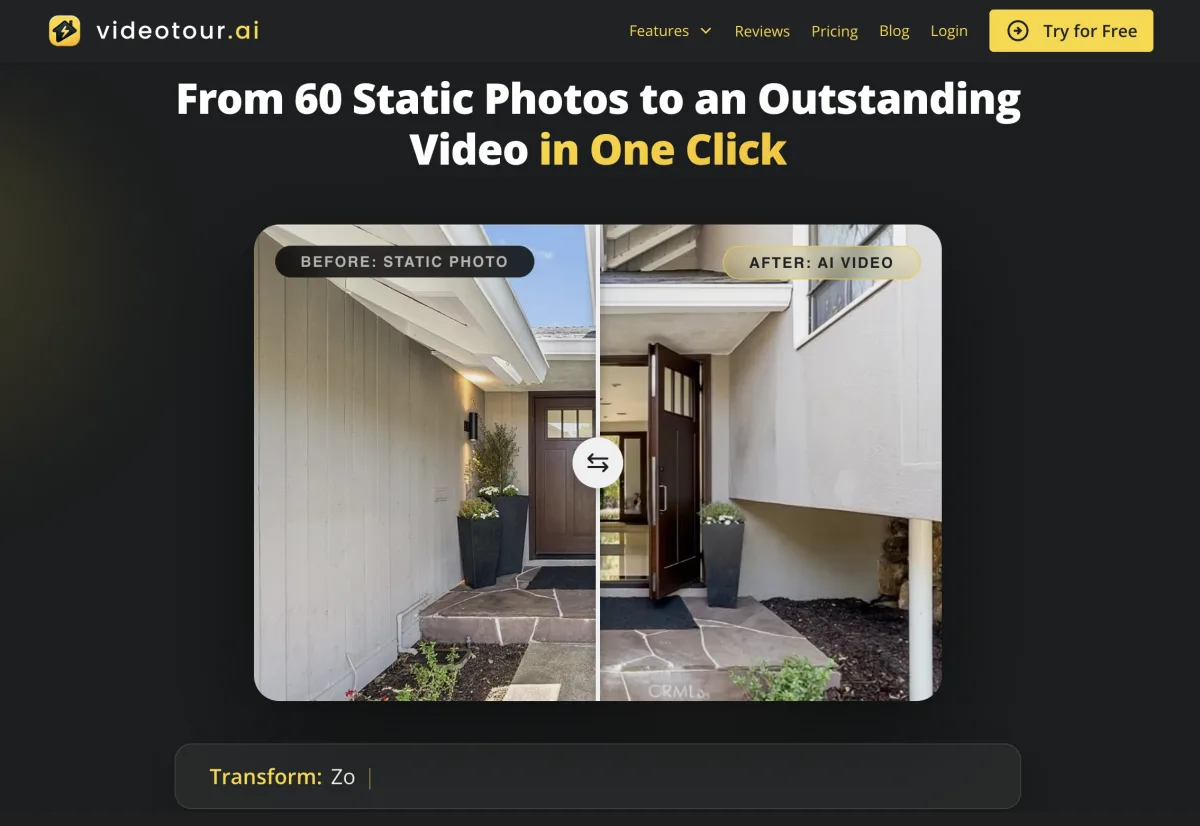
Turn listing photos into narrated video tours in minutes.
No filming, no editing, no gear. Try the AI video tool built for real estate.
How to use AI for marketing & social media
The best AI for real estate marketing mindset is repurposing: one listing should become a week of content. From a single property you can generate the listing description, a just-listed email, Instagram and Facebook captions with hashtags, a set of ad headlines, and a script for your video tour — all in one sitting.
Write 5 Instagram captions for a NEW LISTING. Vary the hooks (question, bold statement, storytelling, list, FOMO). Each 1-2 short lines + 5-8 relevant hashtags.

Listing:
- [BEDS]bd / [BATHS]ba in [NEIGHBORHOOD, CITY], listed at [PRICE]
- Highlights: [e.g., chef's kitchen, pool, walk to downtown]
- Vibe: [modern / cozy / luxury]

Rules: describe the home only (Fair Housing compliant), add a clear CTA (DM/link in bio), and keep language natural, not spammy.
Pair AI copy with design and scheduling tools — Canva for graphics, Metricool to plan and auto-post — so you stay consistent without living in your phone. Our guide to real estate social media tools covers the best options, and these real estate marketing ideas give you a full campaign calendar to fill.
How to use AI for pricing, valuations & market analysis
AI won't set your price, but it will get you to an informed starting point faster. AI-assisted CMA tools like Cloud CMA and RPR (free with your NAR membership) analyze comps, trends, and property attributes to produce a data-backed range in seconds — compare them in our guide to the best CMA software. Predictive analytics can also surface neighborhood-level trends worth mentioning in a pricing conversation.
A word of caution that competitors gloss over: verify every claim before you share it. Vendors publicize eye-catching results — one lending platform, Hitch, reported roughly 30% more loan approvals using AI-driven matching — but your job is to confirm any figure or valuation against your own local data before it reaches a client. AI is the first pass, not the final word.
AI can even generate a floor plan from photos or a quick scan, which adds a professional touch to listings and helps buyers understand flow. For deeper walkthroughs on valuation and pricing strategy, browse our real estate guides.
How to use AI for transactions, paperwork & admin
The least glamorous part of the job is where AI quietly saves the most time. Modern tools can extract key terms from leases and contracts, summarize lengthy disclosures into plain-English bullet points, flag missing signatures or clauses, and power e-signature workflows through tools like DocuSign, Dotloop, and SkySlope — compare the best e-signature tools for real estate to pick one.
AI document tools like Docugami have cut lease-data extraction time by up to 80%, and NAR members get discounted e-signature access through partners like DocuSign.
— Placester; National Association of Realtors member benefits
Use AI to draft and summarize, but always have the responsible professional review anything legally binding. Pair these tools with our real estate transaction checklist so nothing slips between contract and closing.
Can you use ChatGPT for real estate? (with copy-paste prompts)
Yes — and it's probably the best free entry point into AI for most agents. ChatGPT (and Claude, which many agents prefer for longer, more natural writing) can handle a huge share of your daily writing. The two limits to respect: these models can hallucinate — invent plausible-sounding but false facts — and they are not a source of legal, tax, or fair-housing advice. Fact-check numbers, laws, and property specifics every time.
Here's a starter prompt library. Copy, fill in the brackets, and go.
1) COLD-LEAD EMAIL
"Write a friendly re-engagement email to a lead who went quiet 30 days ago, who was looking for [CRITERIA] in [AREA]. Offer value, keep under 100 words, soft CTA."

2) OBJECTION SCRIPT
"Give me a calm, empathetic phone script to handle a seller who says 'Your commission is too high.' Include 2 reframes focused on net proceeds and marketing value."

3) NEIGHBORHOOD GUIDE
"Write a 200-word neighborhood overview of [NEIGHBORHOOD, CITY] for buyers: lifestyle, amenities, and commute. Describe the area only, no protected-class references. Note that I'll verify all facts."

4) OPEN-HOUSE SOCIAL POST
"Write an upbeat Instagram + Facebook post promoting an open house at [ADDRESS] on [DATE/TIME]. Include hashtags and a clear CTA."

5) REVIEW REQUEST
"Draft a short, warm text asking a happy client [NAME] to leave a Google review, with a one-line reminder of what we accomplished together."

6) MARKET UPDATE
"Turn these stats into a 150-word monthly market update for my email list: [median price, DOM, inventory, % change]. Confident, plain-English, not hype. I will verify all figures."
For a full deep-dive with dozens more prompts, read ChatGPT for real estate agents.
How to use AI in commercial real estate & investing
The residential playbook translates directly to AI in commercial real estate and investing, with a data-heavier tilt. Investors and commercial agents use AI to:
- Analyze deals — model cash flow, cap rates, and returns from listing data or a rent roll.
- Parse rent rolls and leases — extract terms, escalations, and expirations from dozens of pages instantly.
- Build wholesaling & off-market lists — identify distressed or high-probability seller leads at scale.
- Optimize portfolios — spot underperforming assets and emerging submarkets.
Same rule applies: treat AI output as a rapid first pass that a human verifies before any capital moves.
AI for property management & landlords
Property managers and landlords have their own fast-growing set of AI use cases, most aimed at cutting the admin and vacancy costs that eat into net operating income:
- Tenant screening — AI scores applications and flags risk signals against income, history, and references far faster than manual review.
- Maintenance & turnover prediction — models forecast which units are likely to need repairs or turn over, so you budget and schedule ahead of the emergency.
- Lease & rent-roll abstraction — AI extracts key terms, escalations, and renewal dates from dozens of leases into a clean, searchable summary.
- AI leasing chatbots — always-on assistants answer prospect questions, pre-qualify renters, and schedule tours around the clock.
Explore the platforms in our guide to property management software, and see the leasing-bot options in our roundup of AI chatbots for real estate.
Will AI replace real estate agents?
No. This is the question every agent quietly asks, so let's be direct: AI replaces tasks, not agents. It can write your listing, but it can't hold a fiduciary duty. It can draft a negotiation script, but it can't read the hesitation on a first-time buyer's face and know when to slow down. It can summarize a contract, but it can't take legal responsibility for the transaction.
What actually happens is a divide: agents who use AI will out-compete agents who don't — not because the software is magic, but because it frees them to spend more time on the relationship-driven work that closes deals. The human moat (trust, negotiation, local expertise, accountability) is exactly what AI can't touch. We cover this in depth in Will AI replace real estate agents?
Risks & guardrails: using AI responsibly
Using AI well means using it responsibly. These are the guardrails that separate professionals from people who get burned:
- Fair Housing & bias. AI can generate discriminatory language without meaning to. Review every listing and ad; never reference family status, race, religion, national origin, disability, or "good schools/safe neighborhood" euphemisms.
- Disclosure. Disclose virtual staging and, where required, AI-generated content. Follow your MLS and brokerage rules.
- Data privacy. Don't paste sensitive client data or confidential documents into public AI tools without checking your brokerage's policy.
- Hallucinations. Fact-check every statistic, legal statement, and property detail. AI is confidently wrong often enough to matter.
- Accountability. You are responsible for everything you send, whether a human or an AI drafted it.
Governance at the brokerage level. If you lead a team or office, put the guardrails in writing. Adopt a formal AI policy that spells out approved tools and data-handling rules, disclose AI-generated content where your state or MLS requires it, and run a Fair Housing check on any AI-written copy before it goes live — never let a model imply a preference about protected classes, even subtly. Above all, keep a human in the loop on anything client-facing: a named person reviews and signs off on AI output before it reaches a consumer. A written policy protects your agents, your clients, and your license.
Handle these well and AI becomes a trustworthy drafting assistant. Ignore them and one bad listing can become a compliance problem.
How to get started with AI this week (30-minute action plan)
You don't need a strategy deck — you need one workflow and 30 minutes. Here's the exact starter plan:
When you're ready to expand, start from our curated hub of the best AI tools for realtors and pick one reviewed tool per category. Master one workflow, then stack the next.
Your 90-day AI adoption roadmap
The 30-minute plan gets you started; this framework turns AI into a system. Work through four phases over a quarter — don't skip ahead.
Assess
Audit your week and pick your two biggest time-sinks — usually listing copy and lead follow-up. Those are your first targets.
Pilot
Add one tool per workflow, in order: writing first, then photos and video, then your CRM. One at a time so each habit sticks.
Integrate
Build templates, a saved prompt library, and repeatable workflows so the output is consistent and you're not starting from scratch each time.
Scale
Systematize it: document the process, train a VA or your team on it, and measure the hours saved so you know what's actually working.
Frequently asked questions
How do real estate agents use AI?
Across the whole funnel: scoring and nurturing leads, drafting listing descriptions and emails, enhancing photos and virtual staging, turning listings into narrated video tours, generating social and ad content, running CMAs, and summarizing contracts. AI produces the fast first draft and handles repetitive work; the agent reviews, personalizes, and owns the relationship.
Can you use ChatGPT for real estate?
Yes. Agents use ChatGPT and Claude for listing descriptions, follow-up and cold-lead emails, objection scripts, neighborhood guides, social posts, review requests, and market updates. Just remember these tools can hallucinate and aren't legal or fair-housing advice — fact-check facts, figures, and laws before you send.
What is the best AI tool for real estate agents?
There's no single winner — it depends on the workflow. Most agents combine a generative assistant (ChatGPT/Claude), an AI-powered CRM, a photo/staging tool, a video tool like VideoTour.ai, and a social scheduler. Our roundup of the best AI tools for realtors compares the leaders by category.
Are there free AI tools for real estate agents?
Plenty. Free tiers of ChatGPT, Claude, Gemini, and Canva cover most writing and design needs, and many paid real-estate tools offer free trials. Start free, prove the time savings on one workflow, then upgrade only what clearly pays for itself.
How do you use AI in real estate marketing?
Turn one listing into a week of content: draft the description, then repurpose it into captions, hashtags, a just-listed email, ad copy, and a video script. Add a scheduler for consistency and keep a human eye on brand voice and Fair Housing compliance.
How do you write listing descriptions with AI?
Feed the AI the facts (beds, baths, square footage, features, neighborhood, target buyer) and ask it to translate features into benefits in your tone. Always review for accuracy and remove any protected-class language. A dedicated listing description generator streamlines this with compliance checks built in.
Will AI replace real estate agents?
No. AI automates tasks, not fiduciary duty, negotiation, or human trust. The agents who win will use AI to spend less time on busywork and more time on relationships and advice.
How can AI help with real estate leads?
Three ways: predictive analytics flag likely sellers, chatbots and voice agents respond instantly around the clock, and generative AI drafts personalized multi-touch follow-up. Faster response and smarter prioritization mean more conversations and appointments.
How is AI used in commercial real estate and investing?
It parses rent rolls and leases, runs deal and cash-flow analysis, builds targeted off-market and wholesaling lists, and helps optimize portfolios. As with residential, treat the output as a first pass a professional verifies before money moves.
Is it safe and legal to use AI for real estate copy?
Yes, with guardrails. Review every AI-written listing for Fair Housing compliance, follow MLS and brokerage rules, keep sensitive client data out of public tools, disclose AI use where required, and fact-check claims. Used responsibly, AI drafts — you stay accountable.
How much does AI for real estate cost?
You can start for $0: ChatGPT's free tier for writing, Canva's free plan for design, RPR (free with NAR membership) for CMAs, and a free CRM for follow-up. A typical paid stack runs about $50–$300 a month across a writing tool, a video tool (VideoTour.ai's first video is free), an AI-powered CRM, and a chatbot — usually less than a single $300–$500 videographer shoot or a $1,500-a-month virtual assistant.
What are the best free AI tools for real estate agents?
The strongest free starter stack is ChatGPT (58% of agents use it) or Claude for writing, Canva for graphics and social, RPR for free CMAs and market data, and a free real estate CRM to keep follow-up on track. VideoTour.ai also gives you your first listing video free. Prove the time savings on one workflow, then upgrade only what clearly pays for itself.
How is AI used in property management?
Property managers use AI to screen tenants and flag risk, predict maintenance needs and unit turnover, abstract key terms and dates from leases and rent rolls, and run always-on leasing chatbots that answer prospects and schedule tours. As everywhere in real estate, a human reviews anything that affects a lease or a legal decision.
The future of AI in real estate (2026 and beyond)
The last three years were about AI drafting content. The next phase is about AI taking action. "Agentic" AI assistants are moving from writing a follow-up email to completing multi-step tasks on their own — pulling comps, building the CMA, drafting the email, and queuing it for your approval. AI voice agents are already qualifying inbound leads in live conversation, and the quality gap with a human ISA is closing fast.
On the consumer side, search itself is changing: buyers increasingly start with conversational, AI-native tools that answer "find me a 3-bed near good transit under $600k" in plain language rather than filtering a portal. The agents who thrive will build predictive, connected stacks rather than a drawer of disconnected apps. Expect to see:
- Agentic assistants that complete multi-step workflows end to end, with you approving the output.
- AI voice agents handling live lead qualification and booking around the clock.
- Conversational property search reshaping how buyers discover homes — and how your listings get found.
- Predictive stacks that connect lead scoring, CRM, and marketing so the "next best action" happens automatically.
None of this removes the agent — it raises the floor on what a single agent can handle. The winners will pair these tools with the human judgment AI still can't replicate.
The bottom line
Learning how to use AI in real estate isn't about chasing every shiny tool — it's about handing the repetitive, first-draft, and around-the-clock work to machines so you can do more of what only a great agent can. Start with one workflow this week, run a prompt, measure the time you save, and stack from there. The agents who build these habits in 2026 will look up in a year with more listings, more time, and a business that runs while they sleep.
Ready to go deeper? Browse the full AI tools directory, compare the best AI tools for realtors, and if video is your next move, try VideoTour.ai free.