
By the Top AI Tools for Realtors editorial team
Has helped agents build geographic farms and lead systems · Last updated July 2, 2026
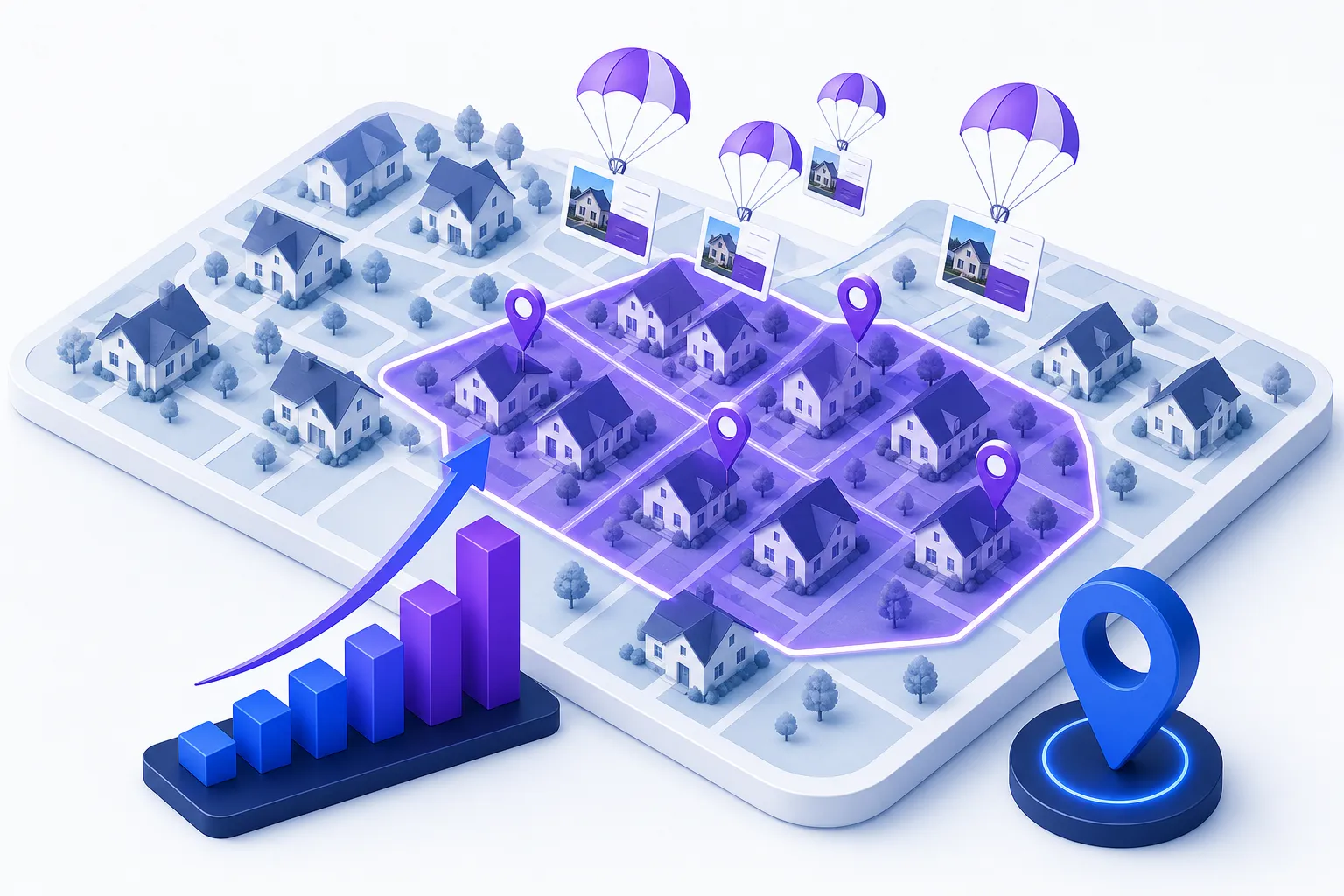
Real estate farming is the practice of marketing consistently to a defined group of homeowners — most often a specific neighborhood — until you become the obvious, top-of-mind agent when they buy or sell. The name comes from agriculture: you work the same field, plant the same seeds every season, and harvest listings and referrals as your brand recall compounds. This is the single most complete, agent-facing playbook for farming in real estate you will find — covering what farming is, how to choose a farm area with actual math, the full marketing system (mail, digital, in-person and video), how to track ROI, and the exact tool stack that makes it run. And unlike every other guide, it lets you calculate whether a specific neighborhood is worth farming, live, right on this page.
Quick answer: Real estate farming means picking a neighborhood (or a demographic) and marketing to it repeatedly — via postcards, door knocking, digital ads and market updates — so you win a predictable share of its listings over time. A good first farm has 250–500 homes, a turnover rate above 6–8%, and no single agent already dominating it. Expect 6–18 months to pay back.
What is real estate farming?
In real estate, the term farming refers to a long-term prospecting strategy where you focus your marketing on one clearly defined audience and stay in front of it relentlessly. Instead of chasing scattered leads across a whole city, you concentrate your time and budget on a manageable area — say, a 400-home subdivision — and become the neighborhood expert everyone recognizes. Over months and years, that repetition turns into listings, buyer referrals and a reputation that competitors can't easily buy their way into.
Farming is a listing-generation engine more than a quick-lead tactic. A single well-run farm can produce a steady stream of seller leads year after year, which is why so many top producers treat their farm as the backbone of their business. It pairs naturally with your broader real estate lead generation plan — farming supplies predictable listing inventory while other channels fill the top of your funnel.
Geographic farming vs. demographic farming
Geographic farming (also called geo farming) targets everyone inside a physical boundary — a neighborhood, subdivision, ZIP code or condo tower. It's the most popular form because the borders are easy to draw, the mailing list is simple to pull, and progress is easy to measure. Demographic farming targets a type of person regardless of where they live — move-up buyers, downsizing retirees, first-time buyers, luxury sellers, or a specific cultural or professional community you have a natural connection to. Many agents blend the two: a geographic farm as the core, with demographic messaging layered on top (for example, a "downsizing" angle in an aging neighborhood). If you're brand new, geographic farming is the easier place to start; see our companion guide on how to get listings as a new agent for how farming fits a first-year plan.
Why farming works — compounding brand recall + listing predictability
Farming works because of two compounding forces. The first is brand recall: marketing research consistently shows people need many exposures before a name sticks, and homeowners don't decide to sell on your schedule. When a family finally lists after seeing 8–12 of your touches, you're the agent they already trust. The second is predictability: any neighborhood turns over a fairly stable percentage of its homes every year. If you know the turnover rate and how much market share you can realistically win, you can forecast your listings and commission income with surprising accuracy — which is exactly what the calculator below does.
Does real estate farming actually work?
Yes — but only if you're honest about what it demands. Scroll through agent forums like r/realtors and you'll see the same verdict repeated: farming absolutely works for agents who commit to consistent monthly touches for a year or more, and does nothing for agents who mail two postcards and give up. There's no hack. The results are real but delayed: most farmers see their first farm listings around months 6–12 and reach "the agent everyone knows here" status around months 24–36. If you can't fund and sustain at least 12 months of consistent marketing, farming isn't the right channel yet — put that budget into faster tactics first and come back to farming when you can commit.
How to choose a real estate farming area (the math)
Picking the right farm is 80% of the outcome. Choose a neighborhood with healthy turnover and no dominant agent and farming almost works on autopilot; choose a stagnant, over-farmed area and no amount of beautiful postcards will save you. Here's how to choose a real estate farming area the way top producers do — with gating questions first, then real numbers.
The 6 gating questions
Before you spend a dollar, a candidate farm should pass all six of these. If it fails two or more, keep looking.
1. Proximity. Is it near where you live or work? You need to be present — knocking doors, popping by open houses, spotting new "for sale" signs. Farming a neighborhood you drive past daily is a genuine advantage. 2. Size. Can you afford to touch every home every month for a year? For a first farm, aim for 250–500 homes. Too small and turnover won't sustain you; too big and you'll run out of budget before recall builds. 3. Turnover rate. How many homes actually sell there each year? You want a turnover rate of 6–8% or higher. Below ~5%, there simply aren't enough listings to justify the spend. 4. Absorption rate. Are homes selling once listed? A healthy market absorbs inventory quickly — aim for an absorption rate above 20% (fewer than ~5 months of supply). Slow markets mean longer days on market and thinner farms. 5. Agent dominance / market share. Is one agent already the "mayor" of the neighborhood? If a single agent owns more than roughly 20% of sales, it's an uphill fight. Open opportunity looks like fragmented listings across many agents. 6. Your fit. Do you genuinely connect with this community and its price point? Farming is a multi-year relationship. If you'd enjoy being the local expert there, you'll show up consistently — and consistency is the whole game.
Turnover rate & absorption rate (the formulas)
Two numbers decide whether a farm can feed you. Pull the raw data from your MLS or a tool like RPR, then plug them into these formulas:
Example: 34 homes sold ÷ 420 total homes = 8.1% turnover → healthy ✓
Absorption rate = homes sold in period ÷ homes currently listed × 100
Example: 6 sold last month ÷ 11 active listings = 55% absorption → strong demand ✓
Months of supply = active listings ÷ homes sold per month = 11 ÷ 6 = 1.8 months (seller's market)
Use these benchmarks as your go / no-go line when you evaluate any neighborhood:
Farm ROI & Area Picker calculator
This is the part every other guide leaves out. Enter your neighborhood's numbers below and the calculator projects the listings you can win, your net commission after your brokerage split, your marketing spend, and your net ROI and payback period — plus a plain verdict on whether the farm is worth it. Adjust any input and the results update instantly.
Tip: 12 postcards a year at ~$1 each ≈ $12/home. Add door hangers, ads or video and it climbs. Leave "homes sold" blank to use the turnover % directly.
Estimates only. Net commission = listings won × sale price × commission % × your keep %. Net profit = net commission − marketing spend. Confirm turnover, absorption and pricing in your MLS before committing budget.
Get the free 12-month Farm Plan template
A ready-to-use mailing calendar (12 touches), budget worksheet and KPI tracker — the exact system this guide describes. Pair it with a real estate marketing plan template for the full picture.
Get the templateBuild your farm plan (12-month system)
Once the math checks out, farming becomes an operations problem: touch every home, every month, without fail. A simple, funded 12-month plan beats a fancy plan you abandon in March. Here's how to build it.
Set your budget & cost-per-door
Work backwards from the calculator. If a 400-home farm can realistically net you two to three listings a year, your marketing budget just needs to stay well under that projected net commission. Most farmers budget on a cost-per-door basis: roughly $2–$5 per home per touch depending on the piece. A jumbo postcard printed and mailed via EDDM (Every Door Direct Mail) can land near $0.50–$1.00 all-in; door hangers, handwritten notes and pop-by gifts cost more but convert harder. Budget for at least 12 touches a year — anything less and recall never compounds. A common starting point: 500 homes × $1 × 12 mailers ≈ $6,000/year, plus $2,000–$5,000 for digital, video and the occasional client event.
Build your farm database & mailing list
You can't farm what you can't reach. Pull your homeowner list and mailing addresses from one of these sources: your MLS (map the boundary and export owner-occupied records), a title company (many will build a farm list for you at no cost as a relationship perk), RPR or a data provider like SmartZip, or an EDDM route from USPS if you're mailing by carrier route rather than by name. Load every address into your CRM so you can track touches, responses and eventually the listings each home produces. If you don't have a CRM yet, start with our picks for the best real estate CRM or a free real estate CRM to keep your farm database organized from day one.
| Month | Primary touch | Goal |
|---|---|---|
| 1 | Intro / "your neighborhood expert" postcard | Brand introduction |
| 2 | Local market report (prices, days on market) | Establish authority |
| 3 | Just Listed / Just Sold postcard | Proof of activity |
| 4 | Free home-value / CMA offer | Seller lead capture |
| 5 | Door knocking + door hangers | Face-to-face recall |
| 6 | Neighborhood market-update video (email + social) | Modern authority |
| 7 | Seasonal / community event invite | Goodwill |
| 8 | Just Sold + "thinking of selling?" postcard | Momentum |
| 9 | Useful resource (vendor list, tax-appeal tip) | Be a resource |
| 10 | Quarterly market report + CMA offer | Seller lead capture |
| 11 | Pop-by gift / handwritten note (top prospects) | Relationship |
| 12 | Year-end recap + holiday touch | Retention & referrals |
Real estate farming ideas & marketing tactics
The best farms mix channels so homeowners see you in the mailbox, at the door, on their phone and around the neighborhood. Here are the real estate farming ideas that actually move the needle in 2026, grouped by channel.
Direct mail — postcards, EDDM & farming letters
Direct mail is still the backbone of most farms because it reliably reaches every home. The workhorses are Just Listed and Just Sold postcards (they prove you're active and quietly advertise that homes in the area are selling), market-update postcards, and real estate farming letters for a more personal touch. Use EDDM when you want to blanket a carrier route cheaply by address, or a named list when you want to personalize. Rotate designs so your farming materials feel fresh, but keep your photo, colors and logo consistent for recall. Vendors like WisePelican and ProspectsPLUS automate the printing and mailing on a schedule, and our free real estate postcard templates give you proven designs and copy to start from.
Door knocking, door hangers & in-person
Nothing builds recall like a face. Door knocking intimidates new agents, but in a farm it's low-pressure: you're the neighborhood specialist dropping off a market report, not a stranger cold-pitching. Leave a door hanger when no one answers so the touch still counts. Host or sponsor small community moments — a shred day, a food-truck night, a photos-with-Santa event — and you convert "the agent who mails us" into "the agent we know." In-person farming compounds everything else you do by mail and online.
Digital farming — geo-targeted ads, local groups & newsletters
Modern farming wraps digital around the mail. Run geo-targeted Facebook, Instagram and Google ads aimed at your farm's boundary so the same households that get your postcards also see you online — a one-two punch that lifts recall dramatically. Become genuinely useful in the neighborhood's local Facebook group, and send a monthly email newsletter with market stats and local happenings. Our roundups of real estate social media tools and real estate email templates make the digital side far faster to run.
AI + video farming (2026)
This is where you separate from the postcard-only crowd. Use AI to draft your farm newsletters, ad copy and postcard headlines in seconds, then personalize by neighborhood. And lean hard into video: a monthly neighborhood market-update video — "Here's what sold on Maple Street this month and what it means for your home's value" — is the single most shareable farm touch you can create, and video packs show up on nearly every farming-related search, so it doubles as SEO — our real estate SEO guide shows how to make those neighborhood pages and videos rank. The fastest way to produce these is VideoTour.ai, which turns listing photos and market data into a polished neighborhood video in minutes so you can publish one every single month without a videographer.
Farm with video — VideoTour.ai
Turn your Just Sold listings and monthly market data into cinematic neighborhood update videos in minutes. Post them to your farm's Facebook group, email list and ads — the most shareable, recall-building touch in your whole farm plan.
Be a community resource (events, sponsorships, local business)
The highest form of farming is becoming genuinely useful. Sponsor the little league team, feature a local business each month, publish a neighborhood vendor guide, or organize a charity drive. These aren't "marketing" in the homeowner's eyes — they're reasons to like and remember you. When a resident finally sells, the agent who showed up for the community wins the listing over the agent who only ever asked for it.
Best real estate farming tools & software
A serious farm runs on a small, coordinated stack: something to print and mail, a CRM to track your database, market data for authority, ads to reinforce recall, and video to stand out. Sort the table by clicking any column header. Every pick below cross-links to our deeper directory coverage where available.
| Tool ▲▼ | Category ▲▼ | Best for ▲▼ | Starting price ▲▼ |
|---|---|---|---|
 WisePelican WisePelican |
Print / mail | Automated farming postcards | ~$0.60/card |
 ProspectsPLUS ProspectsPLUS |
Print / mail | Just Listed / Just Sold campaigns | ~$0.55/card |
 Follow Up Boss Follow Up Boss |
CRM / database | Tracking touches & leads | $69/mo |
 Top Producer Top Producer |
CRM / farming | Farm-focused solo agents | $60/mo |
 RPR RPR |
Data / CMA | Turnover & owner data (NAR) | Free (NAR) |
 Cloud CMA Cloud CMA |
Data / CMA | CMA offers to the farm | $29/mo |
 SmartZip SmartZip |
Predictive data | Predicting likely sellers | $500+/mo* |
 Ylopo Ylopo |
Geo-targeted ads | Digital farming / retargeting | $345/mo* |
 VideoTour.ai VideoTour.ai |
Video | Neighborhood market videos | Free plan |
*Prices are typical 2026 entry points and change often; some require annual contracts. Confirm current pricing with each vendor. Explore more in our full best AI tools for realtors guide and the AI tools directory.
How to measure farming ROI & know it's working
Farming without tracking is just spending. The agents who win treat their farm like a campaign with KPIs, review the numbers quarterly, and adjust before they run out of patience or budget.
KPIs to track
Touches delivered — are you actually hitting all 12+ per home? Consistency is the #1 predictor of results. Response rate — calls, CMA requests, home-value sign-ups, DMs. A rising response rate means recall is building even before listings close. Listings won & market share — your farm listings ÷ total farm sales. This is the number that proves dominance over time. Cost per listing & net ROI — total spend ÷ listings won, and net commission minus spend. Re-run the calculator each quarter with your real numbers.
A monthly market report is one of the highest-converting farm touches and a natural KPI generator — see our guide to building a local market report you can mail and email to the farm.
Realistic timeline & when to adjust or quit
Hold the line for at least 12 months before judging a farm — most first listings arrive between months 6 and 12, and true dominance takes 24–36. That said, don't confuse patience with stubbornness. If after a full year of consistent, on-brand touches you have zero response and zero listings, revisit the fundamentals: was the turnover rate actually high enough? Is one agent quietly dominating? Are your pieces landing and on-brand? Adjust the neighborhood or the message before you abandon the strategy — most "farming doesn't work" stories are really "I picked a bad farm" or "I quit at month four" stories.
Frequently asked questions
In real estate, farming refers to systematically marketing to a defined group of people — most often a geographic neighborhood — over months and years so you become the go-to agent there. Like a farmer working the same field, you plant consistent touches (mailers, door knocks, market updates) and harvest listings and referrals as brand recall compounds.
Geographic farming (geo farming) means choosing a specific neighborhood or subdivision and marketing to every homeowner in it repeatedly. Demographic farming instead targets a type of person — such as move-up buyers, retirees or a cultural community — regardless of location. Most agents start with geographic farming because the boundaries are easy to define and measure.
Pick an area near where you live or work, size it to 250–500 homes to start, confirm a turnover rate of at least 6–8% and an absorption rate above 20%, and make sure no single agent already dominates more than about 20% of sales. Then run the numbers with the Farm ROI calculator above to confirm the projected net commission beats your marketing budget.
Yes, farming works — but only with consistency and patience. Agents who mail and touch a well-chosen farm every month for 12–24 months typically capture a meaningful share of its listings and steady referrals. Agents who send two postcards and quit see nothing. Farming is a compounding brand-recall play, not a quick lead source.
Expect 6–18 months before farming pays back, and 24–36 months to truly dominate an area. The first listings often come from homeowners who saw 8–12 of your touches before they were ready to sell. Budget for at least a year of consistent marketing before you judge results.
For your first farm, 250–500 homes is the sweet spot. It is small enough to touch every home affordably each month yet large enough to produce steady turnover. As your budget grows you can expand to 500–1,000 homes, but never take on more homes than you can consistently market to for a full year.
A typical farm runs about $2–$5 per home per touch. Mailing 500 homes 12 times a year at ~$1 per postcard is roughly $6,000 annually; adding door hangers, digital ads and video can push a serious farm to $8,000–$15,000 per year. Use the Farm ROI calculator to model your exact cost per door and payback.
On a $300,000 sale at a 2.5–3% commission per side, the listing-side gross commission is about $7,500–$9,000. After a brokerage split (often 20–30%), the agent typically nets roughly $5,000–$7,000 before expenses. Farming aims to win enough of these listings each year to far outweigh your marketing spend.
The 3-3-3 rule is a prospecting rhythm: reach out to 3 new contacts, 3 past clients or sphere contacts, and 3 people in your farm every working day. It keeps your database and farm warm with steady, manageable daily activity rather than sporadic bursts of marketing.
A strong farming stack combines a print/mail service for postcards (WisePelican, ProspectsPLUS), a CRM to track your database (Follow Up Boss, Top Producer), market data and CMA tools (RPR, Cloud CMA, SmartZip), geo-targeted digital ads (Ylopo), and video for neighborhood market updates (VideoTour.ai). See the farming tools table above for the full comparison.
Related guides
Farming is one channel in a complete listing and marketing system. Keep building with these:
Real estate lead generation — how farming fits alongside every other lead channel. How to get listings as a new agent — farming as a first-year listing pipeline. Local market report guide — the highest-converting monthly farm touch. Real estate flyer templates and open house templates — print materials for the farm. Real estate email templates — the farm newsletter, done for you. Best real estate CRM and free real estate CRM — your farm database. Best CMA software — CMA offers that turn touches into listings. Real estate social media tools and marketing plan template — the digital and planning layers.