
By the Top AI Tools for Realtors editorial team
Built & mailed thousands of realtor postcards · Last updated July 2, 2026
Postcards are the quietly unkillable real estate marketing channel: a physical card in the mailbox still out-converts most digital ads, and it's the number-one tactic for owning a farm area. This page gives you the three things every other result is missing in one place — free real estate postcard templates you can edit and print, a copy-paste wording swipe file for Just Listed, Just Sold, farming, open house and market-update mailers, and an honest comparison of the AI and print tools that actually design and mail them. Skip to the gallery, grab the swipe copy, or model your ROI with the cost-per-lead calculator.
The real estate postcard template gallery
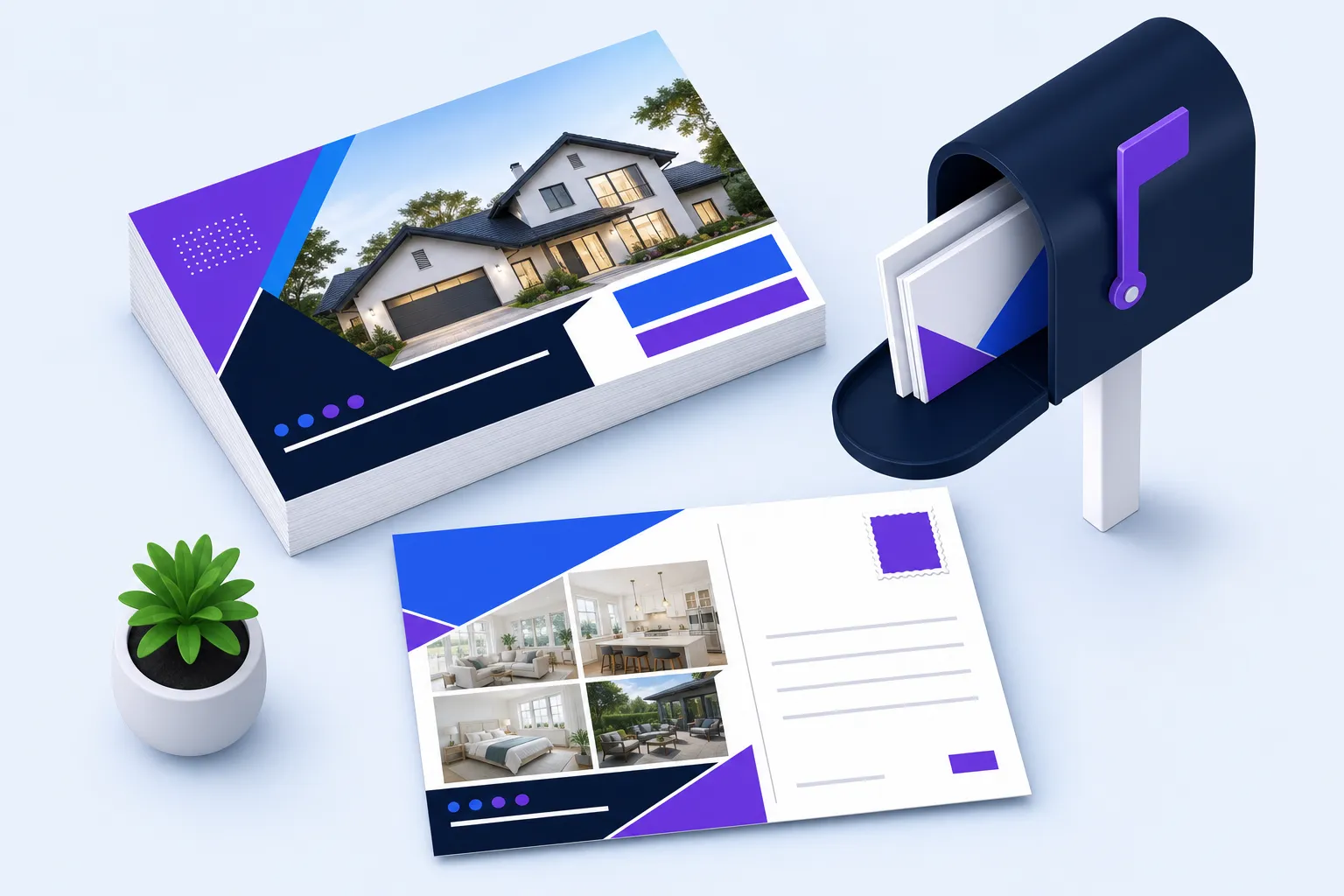
Here are six proven real estate postcard templates rendered at true postcard proportions — a live preview of the front of each design. Use the filter to jump to a use case. Each is a starting point you can recreate for free in Canva or PosterMyWall, or send straight to a mailing service. These are sample real estate postcards you can copy element-for-element: bold headline, big photo area, headshot, one call to action.
in Maple Grove
SOLD on your street
Highland Park
Neighborhood Report
Open House Sat 1–4
warm holiday season
Previews are CSS mockups showing layout and hierarchy — swap the color blocks for your real listing photos when you build the card.
Just Listed postcard templates
A just listed postcard has one job: announce a new listing to the surrounding streets so neighbors think of you (and tell friends who want in). Lead with a big hero photo, a "Just Listed" flag, the basic stats, and a QR code to the full listing or video tour. The just listed wording below gives you the exact headline and body copy. A free just listed postcard template in Canva takes about ten minutes to customize.
Just Sold postcard templates
Just sold postcards are the highest-ROI card in real estate because they prove results to exactly the audience most likely to sell next — the seller's neighbors. Feature the outcome ("Sold in 9 days at 102% of asking"), a line of social proof, and a home-value call to action. This is the classic Remax just sold postcards play, and it works for any brokerage.
Real estate farming / geographic postcards
Real estate farming postcards are mailed to the same 200–500 homes on a repeating schedule to make you the neighborhood's go-to agent. The "I have buyers for your neighborhood" angle is the workhorse. Pair these designs with our geographic farming playbook and the cadence table below to run a real campaign, not a one-off.
Open House invite postcards
An open house postcard invites the immediate neighborhood to your event — great for finding a buyer and meeting future sellers. Keep it simple: date, time, address, one incentive (refreshments, a gift-card draw), and a map or QR pin. Cross-promote it as a full open house marketing kit.
Market Update / Home Valuation postcards
Market-update cards position you as the local data authority. Show the neighborhood's median price movement, homes sold, and days on market, then offer a free instant home valuation. These pair naturally with an automated market report and keep your farm warm between listing events.
Expired listing & FSBO postcards
Expired and for-sale-by-owner postcards target homeowners who already want to sell but haven't closed the deal. The tone is empathetic and results-focused: "Your home didn't sell — here's what I'd do differently." Keep a soft, helpful CTA (a no-pressure strategy call) rather than a hard pitch.
Just Moved / renter-to-buyer & holiday postcards
Holiday, "new neighbor" and renter-to-buyer cards are relationship plays that keep you top-of-mind without a sales ask. Holiday cards earn goodwill and fridge space; renter-to-buyer cards ("Still renting? You may be closer to owning than you think") gently open a buyer conversation. Rotate these into your farming cadence a few times a year.
Copy-paste postcard copy templates (wording swipe file)
This is the part no competitor gives you: ready-to-use postcard wording you can copy in one click. Each block is a headline + body + CTA you can paste straight into Canva or your mailing tool and swap in your details in the brackets. Grab what fits, then make it yours.
Prefer numbers to open houses? Here's your quarter at a glance: the median sale price in [Neighborhood] is [up 4.1%], with [12 homes] sold last quarter in an average of [18 days].Scan for your street's exact figures and a free instant home valuation.
Still renting? You may be closer to owning than you think — let's run a quick rent-vs-buy comparison.Call or text [Name] at [phone] for a free, no-pressure strategy session.
Want the same swipe copy for email and social? Grab our real estate email templates and repurpose any postcard into a Just Listed social post so one listing fuels three channels.
How to design a postcard that gets leads
A postcard has about two seconds between the mailbox and the recycling bin, so hierarchy is everything. The data backs this up: research from direct-mail specialists shows roughly 90% of consumers find personalized, relevant mail useful, and about 85% of people trust a business more when it shows genuine reviews. Your design job is to earn that glance and convert it.
The 5 elements every high-converting postcard has
A bold headline. One benefit-driven line the reader gets in a glance — "Just Sold on Your Street," not "Real Estate Services." A big, real photo. The hero listing or just-sold home fills the front. Multiple property photos on the back can lift response — showing several homes signals activity. Your headshot. A friendly face makes you a person, not a flyer — and dramatically boosts recognition when you farm the same area repeatedly. Social proof. A five-star review line, a recent sale stat, or "#1 in [Neighborhood] this year." Trust is the whole game in real estate. One clear call to action. A single next step — scan this QR code, text this number, get your free valuation. Two CTAs is zero CTAs.
Front vs back layout
Treat the two sides as different jobs. The front is the billboard: hero photo, headline, and your brand — it has to stop the sort. The back is the pitch: supporting photos, the social-proof line, your headshot and contact block, the QR code, and the mailing/address area (leave the bottom third clear for the address and postal indicia). Keep critical text at least 1/4 inch inside the trim so nothing gets cut.
Real estate postcard sizes, postage & specs
"What size should a real estate postcard be?" is the most-asked spec question, and the answer changes your postage. Here's the cheat-sheet. Design everything at 300 DPI with a 1/8-inch (0.125") bleed on every edge, and keep text 1/4 inch inside the trim.
| Size | Best for | USPS postage tier | Pros & cons |
|---|---|---|---|
| 4 × 6 in | Open house, quick announcements | First-Class postcard rate (cheapest) | Lowest postage; can get lost in a stack of mail |
| 5.5 × 8.5 in | Just Listed / Just Sold (most popular) | First-Class letter rate | Best all-rounder — big enough to notice, still affordable |
| 6 × 9 in | Farming & premium listings | First-Class letter rate | Stands out in the mailbox; slightly higher print cost |
| 6 × 11 in (EDDM) | Saturation farming a carrier route | USPS EDDM standard (lowest per-piece, no list needed) | Biggest impact + cheapest bulk postage; must mail whole routes |
Two postage routes matter. First-Class mail needs a mailing list but is faster and forwardable — ideal for targeted Just Listed/Just Sold drops. EDDM (Every Door Direct Mail) lets you blanket an entire postal route without buying a list at the lowest per-piece cost — the workhorse for geographic farming. For a print-ready PDF, export at 300 DPI, CMYK, with crop marks.
Best tools to design & mail real estate postcards
Nobody on page one compares these objectively, so here's the honest breakdown. The right pick depends on whether you want to design free and print elsewhere, or have one tool design and mail for you. Sort the table by any column.
| Tool ▲▼ | Best for ▲▼ | Free templates? ▲▼ | Mailing done-for-you? ▲▼ | From (per piece) ▲▼ |
|---|---|---|---|---|
 Canva Canva |
Free DIY design | Yes — huge free library | Via Canva Print | ~$0.40* |
 ProspectsPLUS! ProspectsPLUS! |
Design + mailing | Yes — RE template sets | Yes — full mailing service | ~$0.55 |
 Wise Pelican Wise Pelican |
MLS auto-fill + lists | Yes — editable in browser | Yes — incl. list builder | ~$0.62 |
 PostcardMania PostcardMania |
High-volume campaigns | Yes — designed for you | Yes — full-service | ~$0.60 |
 Corefact Corefact |
Farming + AVM cards | Yes — RE-specific | Yes — automated farming | ~$0.68 |
 Vistaprint Vistaprint |
Cheap printing | Yes — template store | Direct-mail add-on | ~$0.30 |
 GotPrint GotPrint |
Cheapest bulk print | Bring your own design | Mailing services | ~$0.05* |
 PosterMyWall PosterMyWall |
Free templates | Yes — 200+ RE designs | Print & ship add-on | ~$0.35* |
*Print-only per-piece cost; add postage (~$0.36–$0.56) for mailed campaigns. Prices are typical 2026 entry points — confirm current rates with each vendor.
Canva — free templates, DIY
Canva is the best free option, full stop. Its real estate postcard template gallery has hundreds of editable designs, drag-and-drop simplicity, brand-kit colors, and print bleed built in. Design free, then print in-house, at Canva Print, or export a PDF for GotPrint. Downside: you handle mailing and lists yourself.
ProspectsPLUS! — design + mailing
A real-estate-native shop that does design and mailing end to end. Strong Just Listed/Just Sold and farming template sets, scheduled campaigns, and mailing lists in one place. The best "I just want it handled" pick for agents who don't want to touch a print vendor.
Wise Pelican — MLS auto-fill + list builder
Wise Pelican's edge is automation: MLS auto-fill pulls your listing photos and details into a card automatically, and an advanced list builder targets the exact homes you want to farm. Browser-based editing, automated seller-valuation cards, and per-piece mailing make it a favorite for farming agents.
PostcardMania / Corefact / Vistaprint / GotPrint
PostcardMania is full-service for high-volume campaigns with done-for-you design and tracking. Corefact specializes in automated farming and home-value (AVM) postcards. Vistaprint and GotPrint are the cheapest routes when you already have a design and just need quality printing — GotPrint in particular is unbeatable on bulk price if you handle your own list and mailing.
AI shortcut — auto-fill listing photos & copy
The 2026 workflow is faster: use AI to generate the postcard's photo and copy from the listing itself. Tools with MLS auto-fill pull the photos automatically; an AI writer drafts the headline and body; and instead of a static photo, add a QR code to a cinematic video tour. Produce that walkthrough with VideoTour.ai, then point the postcard's QR at it — a mailbox card becomes a measurable, trackable lead source. Browse the full stack in our best AI tools for realtors hub.
Put a video tour behind your postcard's QR code — VideoTour.ai
Turn listing photos into a cinematic property tour in minutes, host it, and link the postcard's QR code straight to the walkthrough. It's the difference between a card people glance at and one they act on.
The real estate farming playbook with postcards
A single postcard is a lottery ticket; a farming campaign is a business. Farming means picking one neighborhood and mailing it consistently until you own the mindshare. Postcards are the number-one farming tactic — here's how to run them. For the full strategy, see our geographic farming playbook.
How often to mail (every 4–6 weeks, same 200–500 homes)
Pick a farm of 200–500 homes with a healthy turnover rate that isn't already dominated by another agent. Mail the same homes every 4–6 weeks — consistency beats creativity every time. Rotate content so it never feels repetitive: Just Sold, market update, value-add tip, holiday, repeat. Most agents see real listing traction after 6–9 months of steady mailing.
| Farm size | Cadence | Cards / year | What to expect |
|---|---|---|---|
| 200 homes | Every 4 weeks | ~2,600 | Fastest brand recall; best for a tight, high-turnover farm |
| 300 homes | Every 5 weeks | ~3,100 | Balanced reach and budget — the common sweet spot |
| 500 homes | Every 6 weeks | ~4,300 | Wider net; needs a bigger budget and more patience |
Expected response rate & cost per lead
Direct-mail postcards typically pull a 0.5%–2% response rate, and response climbs the longer you farm consistently. What actually matters is your cost per lead and cost per closing — so model it before you spend. Use the calculator below.
Estimate what a campaign costs and what each lead runs you. Adjust the numbers to match your farm.
At a 10% response-to-deal rate that's about 1 deal per mailing — roughly $750 per closing in mail spend.
Benchmarks are illustrative — track your own numbers and the response rate compounds as your farm recognizes you.
Frequently asked questions
Yes. Every template style in the gallery is free to recreate — rebuild them in Canva's free tier, in PosterMyWall, or download a print-ready PDF and edit it. You only pay when you print and mail, and services like ProspectsPLUS!, Wise Pelican and Vistaprint handle that from a few cents to about a dollar per piece.
The four common sizes are 4×6 (cheapest postage), 5.5×8.5 (the most popular all-rounder), 6×9 (stands out in the mailbox) and 6×11 EDDM (largest, best for saturation farming). Bigger cards cost more in postage but get noticed; 5.5×8.5 or 6×9 is the sweet spot for Just Listed and Just Sold mailers. Design at 300 DPI with a 1/8-inch bleed. See the size & postage table.
Lead with a headline like "Just Sold in [Neighborhood]" or "Another one SOLD — yours could be next." Add the outcome (sold in X days, at or above asking), a line of social proof, and one clear CTA: "Curious what your home is worth? Scan for a free instant estimate." Include your headshot, phone and a QR code. Copy our full just sold wording.
Direct-mail postcards typically see a 0.5%–2% response rate, above most digital channels, and response climbs when you mail a farm consistently. At $0.75 per piece and 1% response, 1,000 postcards cost about $750 and generate ~10 responses — model your own numbers with the cost-per-lead calculator.
Geographic farming means picking one neighborhood of about 200–500 homes and mailing it repeatedly to become the area's go-to agent. Mail the same homes every 4–6 weeks — consistency matters far more than any single design. Most agents see meaningful traction after 6–9 months. See the full farming guide.
For free DIY design, Canva. For all-in-one design plus mailing, ProspectsPLUS! and Wise Pelican are the top picks — Wise Pelican adds MLS auto-fill and a list builder. PostcardMania and Corefact suit high-volume farming, and Vistaprint or GotPrint are cheapest if you already have a design. Compare them in the tools table.
Yes. Search "real estate postcard" in Canva, open a free editable template, swap in your listing photo, headline, headshot and QR code, turn on print bleed, and download a 300 DPI print-ready PDF — or order prints and mailing directly through Canva Print.
All-in printing plus postage generally runs $0.45–$1.20 per postcard depending on size, quantity and whether you use First-Class or EDDM standard mail. EDDM is the cheapest per-piece route for saturating a whole carrier route without buying a mailing list.
A bold "Just Listed" headline, a large hero photo of the property, key details (beds, baths, price or "from the $400s"), your headshot and brokerage logo, one clear call to action, and a QR code linking to the full listing or a video tour.
Yes, and you should. A QR code linking to a home-value page or listing video turns a one-way mailer into a measurable lead source. Generate a cinematic walkthrough with VideoTour.ai, host it, then point the postcard's QR code at it so recipients can watch the tour instantly.
Where postcards fit your marketing plan
Postcards work best as one consistent channel inside a bigger system — not a random blast. Fit them into your real estate marketing plan, pair them with a farming campaign and free flyer templates for open houses, and repurpose every design as a social post and email. One listing, five touchpoints. For more channel ideas, see our real estate marketing ideas guide.