
By the Top AI Tools for Realtors editorial team
Investor-deal math for agents & DIY buyers · Last updated July 2, 2026
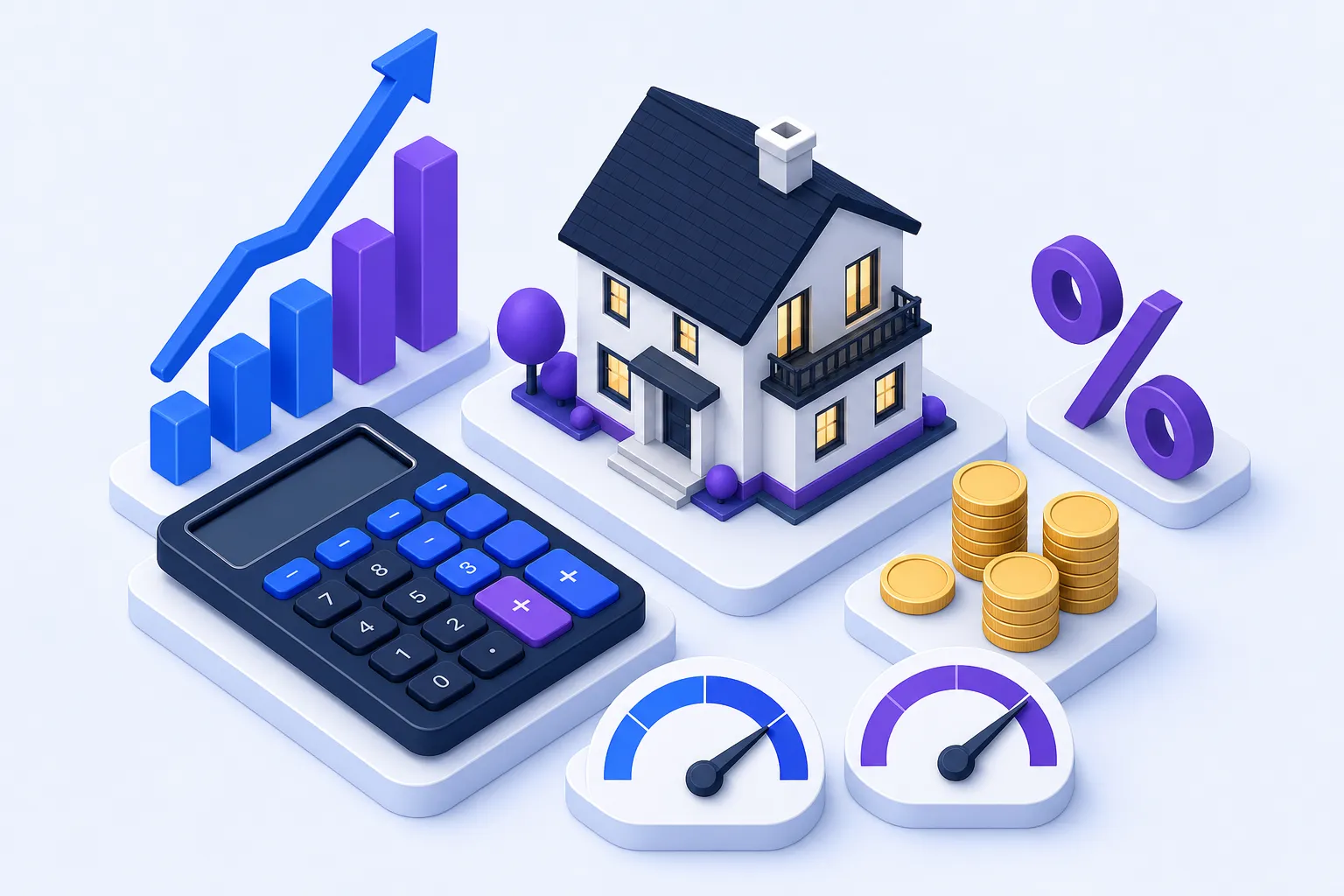
Whether you're an agent advising an investor client or a DIY buyer sizing up your next deal, the fastest way to know if a property is worth pursuing is to run the numbers. This free real estate investment calculator hub does exactly that: a single page with five working tools — a cap rate calculator, a cash-on-cash return calculator, a rental property calculator for cash flow and ROI, a fix-and-flip profit calculator with the 70% rule, and a BRRRR calculator. Every calculation runs instantly in your browser, there's no login and no email wall, and you can copy, print or export any result to Excel or Google Sheets. Below each tool you'll find the exact formula, a worked example, and a benchmark for what counts as a "good" number.
Cap Rate Calculator. Enter a property's price, annual income and operating expenses to see its capitalization rate and net operating income (NOI). Cap rate ignores financing, so it's the cleanest way to compare deals side by side.
Cap rate = NOI ÷ price — NOI is annual income (after a vacancy allowance) minus operating expenses, before any mortgage. Example: a $300,000 property with $21,900 NOI has a 7.3% cap rate.Cash-on-Cash Return Calculator. Cash-on-cash measures the return on the actual cash you put into a deal — down payment, closing costs and rehab — using your annual pre-tax cash flow. It's the leveraged cousin of cap rate.
Cash-on-cash = annual pre-tax cash flow ÷ total cash invested — most rental investors want 8%+. Unlike cap rate, this reflects your mortgage and the leverage of a down payment.Rental Cash Flow & ROI Calculator. The core rental property calculator: rent minus mortgage, taxes, insurance and reserves for vacancy, maintenance, capex and management. It also checks the 1% and 50% rules for you.
Cash flow = rent − mortgage − (taxes + insurance + HOA + reserves) — reserves (vacancy, maintenance, capex, management) are taken as a percentage of rent. The 1% rule flags whether rent ≥ 1% of price.Fix-and-Flip Profit Calculator. Enter the after-repair value (ARV), purchase price and all costs to see your net profit, ROI, and the 70%-rule maximum allowable offer (MAO). This is the house-flipping calculator investors use to avoid overpaying.
MAO = (ARV × 0.70) − repair costs and Net profit = ARV − purchase − rehab − holding − closing − financing. The 70% rule's 30% buffer is meant to cover those carrying costs plus your margin.BRRRR Calculator. Buy, Rehab, Rent, Refinance, Repeat. See how much cash you'd leave in the deal after a cash-out refinance, and what the property cash-flows once it's stabilized.
Cash left in deal = total invested − (ARV × refi LTV) — refinance at 70–75% LTV. The BRRRR dream is a refinance loan that returns most of your capital so you can repeat with little money tied up.All calculations run in your browser — nothing is sent to a server. Figures are estimates; confirm mortgage, tax and insurance numbers with your lender and local records.
Cap Rate Calculator
Capitalization rate (cap rate) is the single most common metric in real estate investing because it strips financing out of the picture. It answers a simple question: if you paid all cash, what annual return would this property's income produce? Because it ignores the mortgage, the cap rate calculator is the fairest way to compare two properties — or a rental against a commercial real estate deal — on equal footing.
Cap rate = Net Operating Income (NOI) ÷ Purchase price × 100Worked example: A fourplex sells for $240,000 and produces $18,000 in NOI after operating expenses (but before the loan). $18,000 ÷ $240,000 = 7.5%. If a comparable building down the street costs $300,000 with the same $18,000 NOI, its cap rate is only 6.0% — you're paying more for the same income.
What's a good cap rate? (benchmark by market)
| Cap rate | Typical market / risk profile | Read |
|---|---|---|
| 3–5% | Prime coastal metros, class-A | Low yield, low risk |
| 5–7% | Growing suburbs, solid class-B | Balanced |
| 7–10% | Secondary/tertiary markets | Strong income |
| 10%+ | Cheaper or higher-risk areas | High yield, verify risk |
As a rule of thumb, a good cap rate is 5–10%. Anything much higher usually signals more risk (rougher neighborhood, older building, thinner tenant demand), not a free lunch. Cap rate is also reversible — divide NOI by a target cap rate to estimate value, which is how a reverse cap rate calculator works.
Cap rate vs. ROI vs. cash-on-cash
| Metric | Formula | Includes the mortgage? |
|---|---|---|
| Cap rate | NOI ÷ price | No — all-cash view |
| Cash-on-cash | Annual cash flow ÷ cash invested | Yes — leveraged view |
| ROI (total) | Total gain ÷ total invested | Yes + appreciation & paydown |
Cash-on-Cash Return Calculator
Cap rate assumes you paid cash — but almost nobody does. Cash-on-cash return corrects for that by measuring the pre-tax cash flow you actually collect against the cash you actually invested (down payment, closing costs and any upfront rehab). It's the number that tells an investor how hard their real dollars are working.
Cash-on-cash = Annual pre-tax cash flow ÷ Total cash invested × 100Worked example: You put $75,000 into a rental (down payment + closing + light rehab) and it nets $5,400/year after the mortgage. $5,400 ÷ $75,000 = 7.2%. Add loan paydown and appreciation and your total return is higher — but 7.2% is the cash yield on day one. A good cash-on-cash return is generally 8%+, though investors in high-appreciation markets will accept less because they expect equity growth to make up the difference.
Rental Cash Flow & ROI Calculator
The rental property cash flow calculator is where a deal lives or dies. Positive cash flow means the property pays you every month; negative cash flow means you feed it. The trap new investors fall into is forgetting reserves — vacancy, maintenance, capital expenditures (roof, HVAC, water heater) and property management. Our calculator bakes those in as a percentage of rent so your number is realistic, not optimistic. And if you end up holding the rental, the best property management software can automate rent collection and shrink that management line item.
Cash flow = Rent − mortgage − (taxes + insurance + HOA + vacancy + maintenance + capex + management)The 1% rule is a fast screen: monthly rent should be at least 1% of the purchase price ($250,000 home → ~$2,500/mo). The 50% rule assumes operating expenses (excluding the mortgage) eat roughly half of gross rent. Both are quick filters — use the full calculator above before making an offer.
What's a good ROI for a rental? There's no single figure because total return blends cash flow, loan paydown, appreciation and tax benefits like depreciation. As a working benchmark, aim for at least an 8% cash-on-cash return; total ROI including appreciation commonly lands in the 10–15%+ range over a multi-year hold. If you want to model the tax side, see our note on rental property depreciation in the real estate terms glossary.
Fix-and-Flip Profit Calculator (with the 70% Rule)
Flipping is a margin business, and the fastest way to lose money is to overpay for the house. The fix and flip calculator above works backward from the after-repair value (ARV) — what the renovated home will sell for — and subtracts every cost between you and the closing table to reveal your net profit and ROI. It also applies the famous 70% rule to cap your offer.
Max allowable offer (MAO) = (ARV × 0.70) − repair costsHow the 70% rule works: if the ARV is $320,000 and repairs are $45,000, the most you should pay is (320,000 × 0.70) − 45,000 = $179,000. The 30% haircut is your buffer for holding costs, buy-and-sell closing costs, hard-money financing and — crucially — profit. Buy above the MAO and you're betting the ARV holds perfectly, which it rarely does.
| Line item | Example flip |
|---|---|
| After-repair value (ARV) | $320,000 |
| Purchase price | $180,000 |
| Rehab budget | $45,000 |
| Holding costs | $9,000 |
| Buy + sell closing | $18,000 |
| Financing costs | $12,000 |
| Net profit | $56,000 |
Once the numbers work and the renovation is done, the job shifts to marketing the property fast. That's where our tool stack comes in — virtual staging software to furnish empty rooms, photo editing for magazine-quality listing shots, and a cinematic walkthrough from VideoTour.ai to drive showings.
BRRRR Calculator
BRRRR — Buy, Rehab, Rent, Refinance, Repeat — is how many investors scale without running out of cash. You buy a distressed property, renovate it to force appreciation, rent it out, then do a cash-out refinance based on the higher after-repair value to pull most of your capital back out. The BRRRR calculator above shows the two numbers that matter: how much cash you leave in the deal, and what it cash-flows afterward.
Cash left in deal = (purchase + rehab + closing) − (ARV × refinance LTV)Worked example: You invest $192,000 all-in (a $140,000 purchase, $40,000 rehab, $12,000 closing/holding). The stabilized ARV is $230,000 and your lender refinances at 75% LTV → a new loan of $172,500. Cash left in the deal = $192,000 − $172,500 = $19,500. Pull back $172,500 of your $192,000, keep a cash-flowing rental, and redeploy into the next deal. A "perfect BRRRR" leaves $0 in the deal — but leaving a little in while keeping positive cash flow is a healthy, repeatable outcome.
How agents use these numbers with investor clients
If you're an agent, running these calculators live on a call is a superpower. Investors don't want a pretty flyer — they want to know the cap rate, the cash-on-cash, and whether the deal clears the 70% rule. Here's how top agents use this page:
Screen fast. Run cap rate and the 1% rule the moment a listing hits, so you only tour deals that pencil out. Present cleanly. Use the copy or print buttons to hand your client a one-page deal summary with cash flow, CoC and MAO. Flag red flags. Thin margins on a flip, negative cash flow after reserves, or a purchase price above the MAO are conversations to have before the offer. Win the listing later. The investor who trusts your numbers on the buy side lists the flip with you on the sell side.
Pro move: pair this page with a real CRM so every investor lead and deal is tracked. See our picks in best real estate CRM (or the free CRM options), then feed it leads with our lead generation tools.
Key metrics & formulas explained
NOI (Net Operating Income) — annual income minus operating expenses, before the mortgage. Cap rate — NOI ÷ price. The all-cash yield; good = 5–10%. Cash-on-cash (CoC) — annual cash flow ÷ cash invested. The leveraged yield; good = 8%+. ROI — total return including cash flow, appreciation, loan paydown and tax benefits. DSCR — NOI ÷ annual debt service; lenders like ≥ 1.25 for rental loans. ARV — after-repair value; the renovated resale price that anchors a flip. GRM — gross rent multiplier; price ÷ annual gross rent, a fast comp check. Rules of thumb — 1% rule (rent ≥ 1% of price), 50% rule (expenses ≈ half of rent), 70% rule (MAO = ARV × 0.70 − repairs).
Export to Excel or Google Sheets
Every calculator on this page includes three export options in its result card. Copy puts a clean text summary on your clipboard to paste into an email or note. Print opens your browser's print dialog so you can save a PDF one-pager for your client. CSV downloads a spreadsheet-ready file you can open in Excel, Google Sheets or Numbers and drop into your own underwriting model — no rental property calculator Excel template or download required.
Best tools to market the deal once the numbers work
Finding a deal is half the job; the other half is selling it. Once a flip is renovated or a rental is turnaround-ready, these tools help agents and investors market the finished property and move it fast.
 VideoTour.ai
Turn listing photos into a cinematic property video tour that drives showings on the resale.
 PropStream
Comps, owner data and off-market lead lists to find and value the next investment deal.
 AirDNA
Short-term-rental revenue and occupancy data to underwrite Airbnb cash flow before you buy.
 DealCheck
Save and organize full underwriting reports on multiple properties to share with clients and lenders.
Need the listing copy too? Our listing description generator writes the resale or rental listing in seconds, and our social media tools and video editors help you promote it. Browse the full AI tools directory or the best AI tools for realtors guide to build your investor tech stack.
Frequently asked questions
A good cap rate is typically 5–10%, depending on market and risk. Lower cap rates (4–6%) are common in expensive, low-risk coastal markets, while higher cap rates (8–12%) appear in cheaper or higher-risk markets. Cap rate is NOI ÷ price, so a higher number means more income per dollar — but often more risk.
No. Cap rate uses net operating income (NOI), calculated before financing. It deliberately excludes mortgage principal and interest so you can compare properties independent of how each is financed. To factor in your loan, use cash-on-cash return instead.
Most rental investors target 8% or higher, though 6–12% is a common range. Cash-on-cash is annual pre-tax cash flow ÷ the actual cash you invested (down payment, closing costs and rehab), so it reflects the real return on the money you put in.
The 70% rule says your maximum allowable offer (MAO) should be no more than 70% of the after-repair value (ARV) minus repair costs: MAO = (ARV × 0.70) − repair costs. The 30% buffer covers holding costs, closing costs, financing and your profit margin.
There's no single number, because total return blends cash flow, loan paydown, appreciation and tax benefits. As a cash-flow benchmark, many investors want at least an 8% cash-on-cash return; total ROI including appreciation often lands in the 10–15%+ range over a hold period.
Cash flow = rental income − all operating expenses − debt service. Operating expenses include property tax, insurance, HOA, management, and reserves for vacancy, maintenance and capital expenditures. Debt service is your mortgage principal and interest. What's left over each month is your cash flow.
The 1% rule is a quick screen: monthly rent should be at least 1% of the purchase price (a $200,000 home should rent for ~$2,000/mo). The 50% rule estimates that operating expenses (excluding the mortgage) will consume about half of gross rent. Both are rough filters, not substitutes for a full cash-flow analysis.
BRRRR stands for Buy, Rehab, Rent, Refinance, Repeat. Cash left in the deal = total cash invested (purchase + rehab + closing/holding) − the new refinance loan (typically 70–75% of ARV). If the refinance returns most of your capital, you can repeat with little money tied up.
Yes. Every calculator has a CSV export button that downloads your inputs and results as a spreadsheet-ready file for Excel or Google Sheets, plus copy-to-clipboard and print-to-PDF buttons to save or share a one-page deal summary with your client.
Cap rate = NOI ÷ price and ignores financing, so it compares properties as if bought in cash. Cash-on-cash = annual cash flow ÷ cash invested and reflects your leveraged return on the money you actually put in. ROI is the broadest term — total return including cash flow, appreciation, loan paydown and tax benefits over your hold.
Run the numbers, then market the deal
Great investing comes down to great math followed by great marketing. Use the calculators above to screen deals with confidence — cap rate to compare, cash-on-cash and cash flow to judge the hold, and the 70% rule and BRRRR math to protect your capital. Then, once a deal pencils out, turn to our tool guides to sell it faster.