
By the Top AI Tools for Realtors editorial team
Covers the AI tools, apps & measuring standards agents use · Last updated July 2, 2026
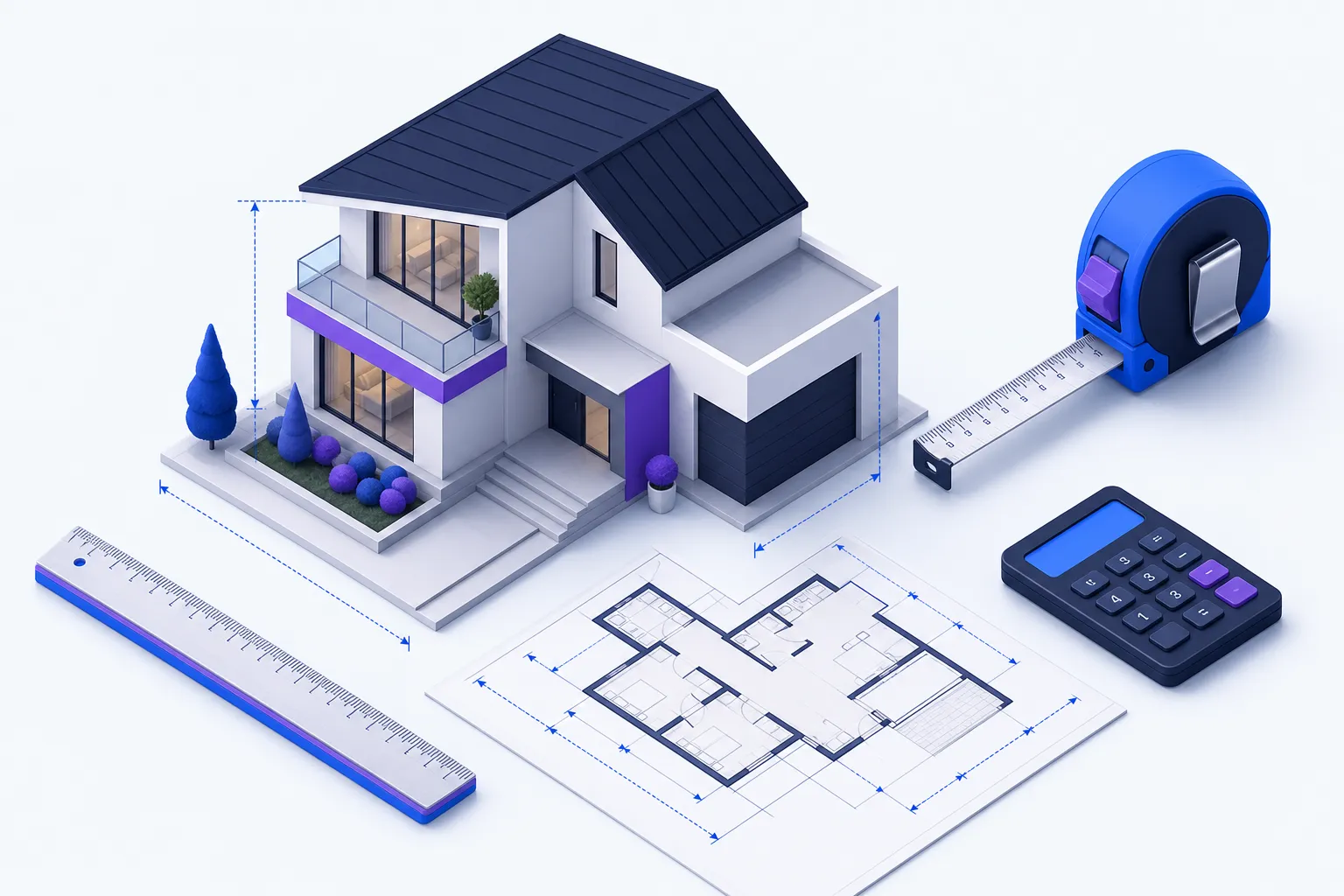
Square footage is the single number that drives a home's price, its appraisal, its property taxes, and every flooring, painting or insurance quote you'll ever get — yet almost nobody measures it correctly. The short version: to measure the square footage of a house, sketch a floor plan, measure each finished room's length × width in feet, add up the finished, above-grade rooms, and exclude anything that doesn't count (the garage, unfinished spaces, and any ceiling under seven feet). That method mirrors ANSI Z765, the national standard that now governs Fannie Mae and Freddie Mac appraisals. Below you'll find the exact step-by-step process, a plain-English breakdown of what counts as gross living area (GLA), a rules table that settles the garage/basement/attic debates, the AI apps that measure a whole house from your phone — and a free calculator to add it all up.
Quick answer: how to measure square footage in 4 steps
Here's the whole method in four steps. It works for a studio or a five-bedroom colonial, and it's how to calculate the square footage of a home the way an appraiser would.
- Sketch a floor plan. Draw a rough top-down outline of each level and label every room. You'll record dimensions right on the sketch so nothing gets double-counted or missed.
- Measure each room, length × width. Measure every finished room in feet — to the interior faces of the exterior walls — and multiply length by width to get that room's square footage.
- Add up the finished, above-grade spaces. Sum every heated, finished room that sits at or above ground level. That total is the home's gross living area (GLA) — the headline square-footage number.
- Exclude what doesn't count. Leave out the garage, the unfinished basement or attic, open two-story areas (count the floor once), and any space with a ceiling under seven feet.
The one formula
Total square footage = the sum of (length × width) for every finished, above-grade room.
Try our free square footage calculator
Add one row per room, type the length and width in feet, and the total updates live. Toggle “count only GLA” to exclude the rooms you mark as garage, unfinished, or below-grade — the same distinction appraisers make. Add a price-per-square-foot figure to estimate a flooring, carpet, or painting job. This is the same 201k-searches-a-month square footage calculator everyone hunts for, built right into the guide.
Tools you'll need to measure a house
You can measure a whole house with a $10 tape measure, but the right tools cut the time — and the errors — dramatically. Here's how the three main approaches compare.
| Method | What you need | Speed | Accuracy | Best for |
|---|---|---|---|---|
| Tape measure | 25-ft tape, graph paper, pencil, calculator | Slow | Good (if careful) | One or two rooms; flooring quotes |
| Laser measure | Laser distance meter (Leica DISTO, Bosch) | Fast | Excellent (±1/16″) | Whole homes, done solo |
| Floor-plan app | Smartphone (CubiCasa, magicplan, RoomScan) | Fastest | Very good + ANSI GLA | Agents who need a plan & GLA |
Whichever you choose, always sketch the floor plan first and record each measurement as you take it. A AI floor plan generator can even build the sketch and the math for you — more on that below.
Step-by-step: measuring room by room
This is the core of the whole process. Work one floor at a time, and measure to the inside face of exterior walls so your rooms add up to the building's true footprint.
Measuring rectangular rooms (worked example)
Most rooms are simple rectangles. Measure the length, measure the width, and multiply. Say a primary bedroom is 15 ft long and 12 ft wide: 15 × 12 = 180 square feet. A 20 × 14 living room adds another 280 sq ft. Record each number on your sketch and keep a running list. When you're done, add the rooms together — or drop them into the calculator above.
Measuring L-shaped and irregular rooms
Don't try to measure an odd shape in one shot. Split it into rectangles. An L-shaped great room becomes two boxes: measure each box's length × width, then add them. For example, a room that's a 16 × 12 rectangle plus a 6 × 8 alcove is (192) + (48) = 240 sq ft. Closets, bump-outs and bay windows are just small rectangles — add each one. Curved walls? Take the widest length and width and accept a small margin, or let an app trace it.
Measuring from the outside (exterior method)
Appraisers frequently measure the exterior because ANSI defines the boundary at the outside walls. To measure the square footage of a house from the outside, walk the perimeter of each finished level and measure the outside footprint wall-to-wall, breaking the shape into rectangles just as you would inside. Add the rectangles for each floor, then subtract the garage and any open or unfinished sections. The exterior method is faster for the overall footprint but you still need interior checks to separate finished from unfinished space.
Using Google Maps for a rough estimate
Can you measure a house's square footage on Google Maps? For a ballpark, yes. Right-click a corner of the roof in Google Maps, choose “Measure distance,” and trace the outline to get an approximate footprint. But this measures the roof — including overhangs and the garage — not finished interior GLA, and it can't see a second story. Treat it as a sanity check, never as a number you'd put on a listing or an insurance form.
The ANSI Z765 standard (what appraisers use)
Here's the piece the friendly consumer guides skip and the appraiser PDFs make unreadable. ANSI Z765 is the American National Standard for measuring the square footage of single-family homes. The current edition, ANSI Z765-2021, is the one that matters in 2026: Fannie Mae has required it for conventional appraisals since April 2022, and it's baked into the new Uniform Appraisal Dataset (UAD 3.6) and the redesigned URAR appraisal report that lenders are rolling out. In plain English, ANSI exists so that everyone — appraiser, agent, tax assessor — measures the same way and arrives at the same number.
The rules that matter most:
The 7-foot ceiling rule. Finished space must have a ceiling at least seven feet high to count. Under a sloped ceiling, space counts if it's at least five feet high — and at least half the room must meet the seven-foot minimum. Finished area only. The space must be finished, heated living area — walls, flooring, and a permanent heat source. Unfinished storage doesn't count. Measured to the exterior walls. Square footage is calculated to the outside faces of exterior walls, so wall thickness is included in the footprint. Round to the nearest square foot. Final areas are reported to the nearest whole square foot.
Above-grade vs below-grade (why basements are separate)
ANSI draws a hard line between above-grade and below-grade space. If any part of a level is below the surrounding ground, the entire level is below-grade — and below-grade area (even when beautifully finished) is never included in the above-grade gross living area. It's reported separately. That's why a walkout basement, a daylight basement, or a finished lower level shows up as its own line on an appraisal instead of inflating the GLA. It's not that a finished basement has no value — it does — it just can't be sold as the same square footage as the main floors.
What counts as square footage (and what doesn't)
This is the section everyone actually searches for. Use the table to settle the “does this count?” debates at a glance — then read the notes below for the gray areas. ✅ counts toward GLA, ⚠️ counts but is reported separately, ❌ never counts.
| Space | Counts? | Why |
|---|---|---|
| Attached garage | ❌ No | Unfinished and unheated — excluded even if attached. |
| Finished basement | ⚠️ Separate | Counts as living area but is reported below-grade, not in GLA. |
| Unfinished basement | ❌ No | Not finished, heated living space. |
| Finished attic (7-ft ceiling) | ✅ Yes | Counts if finished and it meets the ceiling-height rule. |
| Unfinished attic | ❌ No | Storage, not living area. |
| Enclosed heated porch / sunroom | ✅ Yes | Counts if finished and heated by the home's system. |
| Screened / open porch | ❌ No | Not enclosed or heated. |
| Open two-story foyer / open-to-below | ❌ No | The floor below is counted once; the open void isn't counted again. |
| Stairs | ✅ Yes | Included in the area of the floor they descend from. |
| ADU / detached guest house | ❌ No | Detached structures are measured and reported separately. |
| Mobile / manufactured home | ✅ Yes | Measured to exterior walls like any home; tow hitch excluded. |
Does a garage count as square footage?
No. A garage — attached or detached — is unfinished, unheated space, so it's excluded from gross living area every time. This is the most common way listings get inflated. The only path to counting former garage space is a full, permitted conversion to finished, heated living area that meets the ceiling-height rule; even then, many appraisers note it separately because buyers still read it as a garage.
Does a finished basement count as square footage?
A finished basement usually counts as living area, but not as above-grade GLA. Because it sits below grade, ANSI requires it to be reported separately — you'll often see it on the MLS as “below-grade finished” square feet. So a home advertised as “2,400 sq ft” with a finished basement might really be 1,800 sq ft above grade plus 600 below. That distinction matters enormously for pricing and appraisal, which is why lumping them together is a classic (and costly) mistake.
Attics, porches, and other gray areas
A finished attic counts only if it's finished and enough of it clears the seven-foot ceiling minimum (five feet under the slopes). An enclosed, heated sunroom counts; a screened or three-season porch doesn't. Bonus rooms over a garage count if they're finished, heated, and accessed from the living area. When in doubt, apply the same three tests: is it finished, is it heated, and does it clear the ceiling rule?
Gross living area (GLA) explained
Gross living area (GLA) is the finished, above-grade, heated living space of a home — the headline number that drives comps and appraisals. It's different from total living area or total square footage, which may add below-grade finished space (a basement) and, on some records, unfinished area. That's why the same house can be “1,850 sq ft” on an appraisal (GLA) and “2,450 sq ft” on a tax card (total, including the basement).
On MLS listings you'll see abbreviations that map to these ideas: GLA (gross living area / above-grade finished), TLA (total living area), SqFt Above Grade and SqFt Below Grade. Reading them correctly is the difference between an accurate comparison and an overpriced listing. When you write the listing, keep the number honest and let a strong listing description generator do the selling — not an inflated square-footage figure.
AI & apps that measure square footage automatically
The modern, error-proof way to get accurate GLA is to let software do the measuring. These tools turn a phone walkthrough into a scaled floor plan with ANSI-compliant square footage — no tape measure, no math, no disputes. This is where forward-thinking agents are heading, and it pairs naturally with the rest of an AI listing workflow.
| Tool | How it measures | ANSI GLA output | Best for | Price |
|---|---|---|---|---|
 CubiCasa CubiCasa |
Phone-camera walkthrough → floor plan | Yes, ANSI GLA | Agents & photographers | From ~$0.90/scan |
 magicplan magicplan |
AR / LiDAR room scanning | Area per room | DIY & contractors | Free tier; from $10/mo |
 RoomScan Pro RoomScan Pro |
Tap walls / LiDAR auto-plan | Area per room | Quick single rooms | From ~$5/mo |
 Matterport Matterport |
3D capture → plan + measurements | Yes (add-on) | Virtual tours + measurements | Free tier; from $10/mo |
 Leica DISTO (laser) Leica DISTO (laser) |
Handheld laser distance meter | Manual | Fast, precise manual measuring | From ~$60 |
CubiCasa is the standout for agents: you walk the home filming with your phone, upload, and get a professional floor plan with ANSI GLA back — usually within hours. magicplan and RoomScan Pro use AR/LiDAR for solid DIY plans, while a Leica DISTO or Bosch laser is the fastest manual route. Want the plan and the marketing in one place? Our AI floor plan generator turns photos into a clean 2D plan with dimensions, and you can browse every option in the AI tools directory.

Once you have an accurate floor plan, market it
Pair your GLA and floor plan with a cinematic AI video tour from VideoTour.ai — the fastest way to turn listing photos into a scroll-stopping walkthrough. See our full VideoTour.ai review.
Common square-footage mistakes (that cost money)
Square-footage errors aren't rounding errors — they're pricing errors, and they show up in real dollars. The worst offenders:
Counting the garage or an unfinished basement. The fastest way to inflate a listing — and the fastest way to lose the deal at appraisal. Measuring to interior instead of exterior walls. ANSI measures to the outside; interior-only measurements come up short. Ignoring the ceiling-height rule. Low, sloped attic space that doesn't clear five feet simply doesn't count. Trusting tax records. Assessor figures are often old, exterior-only, or measured under different rules. Double-counting open spaces. A two-story foyer is counted once, on its floor — not twice.
The dollar math: imagine a home priced at $200/sq ft. If it's listed at 2,000 sq ft but really measures 1,850, that's a 150 sq ft, ~$30,000 discrepancy — enough to blow up an appraisal, kill the buyer's financing, or expose the agent to a misrepresentation claim. Accurate measurement isn't pedantry; it's risk management.
Why accurate square footage matters
Square footage touches nearly every dollar in a transaction:
Pricing & comps. Price-per-square-foot is the backbone of every CMA. Wrong footage, wrong price. Appraisals & financing. Appraisers measure to ANSI; a mismatch can sink the loan. Property taxes. Assessments are partly footage-driven; errors cost owners for years. Insurance & replacement cost. Coverage is priced on livable area — measure for insurance the same careful way. Flooring & renovation quotes. Every material estimate starts from square footage — the reason the calculator above has a price-per-sq-ft field. MLS & legal liability. A misstated figure is a disclosure problem; accurate measurement protects you.
Once you've nailed the number, the rest of the listing gets easier — from photo editing and virtual staging to the video tour that shows the space off. For the bigger picture on where these tools fit, see our guide to how to use AI in real estate.
Free download: Home Measuring Worksheet + ANSI cheat-sheet
Want to take this on-site? Our printable Home Measuring Worksheet gives you a room-by-room grid to record length, width and finished/above-grade status, plus a one-page ANSI Z765 cheat-sheet (the 7-foot rule, above/below-grade, and the what-counts table) updated for UAD 3.6. Print it, clip it to your sketch, and you'll never guess at a number again.
Frequently asked questions
Sketch a floor plan, measure each finished room's length × width in feet, multiply to get each room's area, then add up all the finished, above-grade rooms. Exclude the garage, unfinished spaces, and anything with a ceiling under seven feet, following the ANSI Z765 standard appraisers use. You can add it all up with the calculator above.
No. An attached or detached garage is unfinished and unheated, so it's never included in a home's gross living area under ANSI Z765. A fully permitted conversion to finished, heated living space can make it count — but only if it meets the ceiling-height and finish requirements.
A finished basement usually counts as living area, but because it sits below grade it must be reported separately from the above-grade gross living area (GLA) — not lumped into the main square footage. MLS listings often show it as “below-grade finished” square feet.
ANSI Z765 is the American National Standard for measuring single-family square footage. It defines gross living area as finished, above-grade space with a ceiling of at least seven feet (five feet under sloped ceilings), measured to the exterior walls. Fannie Mae has required ANSI Z765-2021 for conventional appraisals since April 2022 under UAD/URAR.
Gross living area (GLA) is the finished, above-grade, heated living space of a home. Total square footage often adds below-grade finished areas (like a basement) and sometimes unfinished space, which is why an MLS “total” figure can be larger than the appraised GLA.
Walk the exterior and measure the outside footprint of each floor wall-to-wall, breaking the shape into rectangles. Add the rectangles for each finished level, then subtract any open or unfinished sections and the garage. Measuring to the exterior walls is exactly how ANSI Z765 defines the boundary.
Only as a rough estimate. Google Maps' measure-distance tool lets you trace a roof outline, but it captures the roof footprint (including overhangs and the garage) rather than finished interior GLA, and it can't see multiple stories. Use it for a ballpark, never for a listing or appraisal.
Tax assessors often measure from the exterior, use older records, or include areas ANSI excludes, while the MLS figure may come from an appraisal, a floor-plan app, or the agent. Different measuring rules and outdated data mean the two numbers frequently disagree by hundreds of square feet.
Under ANSI Z765 a finished area needs a ceiling height of at least seven feet to count. Under sloped ceilings, space counts as long as it's at least five feet high, and at least half of the room's finished floor area meets the seven-foot minimum.
CubiCasa is the leading app for agents — you walk the home with your phone camera and it returns an ANSI-compliant floor plan and GLA. magicplan and RoomScan Pro are strong DIY options, and a laser measure like the Leica DISTO is the fastest manual method. See the tools comparison above.
The bottom line
Measuring a house isn't hard once you know the rules: sketch it, measure each finished room length × width, add the above-grade spaces, and follow ANSI Z765 for what counts. Get it right and you protect your price, your appraisal, and your reputation. Better yet, let software do the measuring — an AI floor plan generator or a tool like CubiCasa turns a phone walkthrough into an accurate, ANSI-ready floor plan in minutes, so you can spend your time selling instead of doing arithmetic.